Showing posts with label Acadian. Show all posts

Sunday, August 21, 2016

Julien L'or dit Lamontagne: Act Inacheve (Unfinished Act)

Today I am reviewing some the the L'or or Lord lines in our families and found a void. A real void, that is, there is an empty space where there should be writing. A parish register from  "The Registers of St.Jean-Baptiste, Port Royal, 1702-1755 has the name "Julien L'or" written in the left hand margin but there is absolutely no writing!  For those researchers familiar with the style and format of the French Catholic parish registers of Quebec and Acadia, this is a glaring error.  For those reading this story who are unfamiliar with this format, I can only tell you that the dear Cure Charlemagne Cuvier may have tied one on the night before. The empty section occurs between the 17th of February and the 3rd of May, 1724. It must have been a long winter!


Who was Julien L'or anyway? Julien was an early habitant in Acadia, not one of the earliest but he arrived before 1675, probably from France and may have been in Quebec before his arrival in Acadia. Besides being the progenitor of the Lord family, he was a 6th great grandfather of Al, Claire and Ray Rivet and through a marriage also an ancestor of Dorothy Wills. He was born about 1652 and married Anne-Charlotte Girouard about 1675.  Julien and Anne-Charlotte had nine children and the Rivets descend from two of those children, Pierre L'or and Marguerite L'or. Al, Claire and Raymond Rivet's grandmother was Marie Lord, daughter of Solomon Lord, born in St. Jacques de l'Achigan in 1854.

Julien L'or and Anne-Charlotte lived and raised their family on the western side of the River Dauphin, slightly northwest and across the river from Port Royal. In  the 1686 census of Port Royal Julien and Anne-Charlotte are listed as 33 and 26 years old with 4 children: Alexandre 10, Jacques 8, Pierre 5, and Marie 1 year old.  Cattle and sheep are not enumerated on their entry. On this map, you can find their domain:


and the detail...


It is possible that Julien was buried in the cemetery of the church of St Jean Baptiste in Port Royal, present day Annapolis Royal, Nova Scotia. With a blank entry, who knows exactly what occurred to Julien when he died.  Could he have drown in the River Dauphin and his body never found?

In July, I had an opportunity to walk through the oldest section of the St. John Baptiste cemetery guided by Alan Melanson on the Acadian Ancestral Tour. Julien L'or's remains may have been close by and under our footsteps....even though he has a blank entry in the place where his burial should be recorded!


Here is the line from Claire, Al and Ray Rivet, siblings born in Cohoes NY between 1916 and 1922, who were the children of:
 Paul Emile Rivet 1880-1961, born in St Jacques de l'Achigan, son of 
  Marie Lord , 1854-1914, born in St Jacques de l'Achigan, daughter of
   Solomon Lord, 1827-1913, born in St Jacques de l'Achigan, son of
    Louis Thaddee Lord, 1784-1858, born in St Jacques de l'Achigan, son of
     Jean Baptiste Lord dit Talaron, born 1761 in exile in Connecticut Colony, son of
      Louis L'or, 1722-1781, born in Port Royal, Acadia, son of 
       Pierre L'or, 1682- 1738, born in Port Royal, son of
        Julien L'or dit Montagne and Anne-Charlotte Girouard


Friday, August 19, 2016

Acadian Family Update


Six years ago I started writing about the Acadian Ancestors in the three families I research most intensely - the Mylott family of Waterford & Whitehall New York, the Rivet family of Cohoes New York, and the Wills family of upstate New York, Cornwall and Quebec.  In the past six years I have learned a lot about them through reading & researching and getting help from a special lady, Lucie LeBlanc Consentino, who hosts the website Acadian Ancestral Home.  Thanks to Lucie and her sharing, I think I'm able to explain to others and to myself the story of these ancestors with some accuracy and confidence.  It is a big story and vast history involving Acadian families being pushed and pulled across the globe and throughout the English, French and Spanish colonies of the mid 18th century. For me personally, it is a history that brought the ancestors of the Rivets, Mylotts and Wills together 200 years before Al Rivet, Claire Rivet, Ray Rivet, Arthur Mylott, and Dorothy Wills came together in the working class neighborhoods of Cohoes and Waterford, New York.  For this reason, the story of the Acadians in my families will always be the centerpiece of my family's genealogy. Antoine Bourg and Antoinette Landry who married about 1642 and a founding couple of Acadia, are common ancestors of Al Rivet, Claire Rivet, Ray Rivet, Arthur Mylott and his siblings (Milo and Edgar), and Dorothy Wills and all her siblings (Celina, Julia, Anna, John, Elizabeth, Muriel Etta, Larry and Robert).  The Rivet family emigrating from St Jacques de l'Achigan and the environs of Joliette, Quebec certainly have an overwhelming number of Acadian ancestors who resettled in this areas after the exile.  Some Mylott and Rivet ancestors were thrust together on the journey and drama of "The Pembroke". Some Wills ancestors were exiled to the port of Boston where the dying words of our 6th great grandmother, Jeanne Hebert, were recorded by Timothy Hutchinson, a later governor of Massachusetts colony, in 1755.*

FrancoAmerican Gravy & Lucie LeBlanc Consentino
on tour July 2016
During July 2016, I was fortunate to be able to travel with Luce's Acadian Ancestral Tour for a week to historical sites, memorials, museums, churches, rivers, shores with Fundy tides that are a part of Acadian history. This included locations in present day New Brunswick, Prince Edward Island and Nova Scotia.  The bonus was traveling with 40+ Acadian cousins who are all lovers of genealogy and history - especially Acadian genealogy and history.  Planning and preparation for the tour started more than one year before with Sandra Goodwin of Maple Starts and Stripes and Lucie researching sites and securing the travel services of Fred Clark.  Forty plus adults and one easy going teenager had the trip of a lifetime!  Merci and thanks to everyone.  Soon, I hope to post some of the photos I took and reflections I felt during this amazing tour.

A quiet moment inside the Magical Mystery Tour Bus


Below is a recap of the stories written about Acadians in this blog so far.  This list includes some early posts that may not have been well researched but I am reviewing them for accuracy and hope they will "make the cut"!

Sunday, July 19, 2015

If Smithsonian historians can research PTSD and the Civil War, can we also research the Acadian Deportation and PTSD?


Seems there is a lot out on the internet about the historical basis of PTSD. One of the most interesting articles is Civil War soldiers and post traumatic stress disorder.  If researchers can dig into primary sources from the mid nineteenth century about PTSD,  could it be possible to leap one hundred years before to the period of the Acadian deportation and research the same thing?

Below is a recap of the stories written about Acadians in this blog so far.  This list includes some early posts that may not have been well researched but I am reviewing them for accuracy and hope they will "make the cut"!


"Almost an idiot"


OR 

Did Acadians commonly suffer from what we now call

Post Traumatic Stress Disorder (PTSD) 

after the Grand Derangement?

Or was 

Geoffroi Benoit the only one with documented mental illness 

after the deportation??


Joseph Godefroy/Geoffroi/Godfroi Benoit and his wife, Madeleine Babin are ancestors of the nine Wills children who are subjects of this blog. Documents in the Commonwealth of Massachusetts State Archives describe Joseph Geoffroi Benoit as 'almost an idiot' and "disordered in his senses."  He and Madeleine just endured 'le grand derangement' - the expulsion from Acadia along with their children. He was arrested along with other Acadian men and boys in the church, marched to a ship in the harbor, probably watched his home being torch and his wife and  children being brutally forced onto boats.  Geoffroi and his sister Marie's families were exiled to Boston without food and material possessions.  His mother, Jeanne Hebert, died on the docks days after the overcrowded ship arrived in Boston.  She had lain sick above a fortnight without ay care'.

A communication from Michael B. Melanson (the Melanson Family genealogist) brought this  description of Geoffroi Benoit to my attention via a FB communication. In his work, "Melanson-Melancon: The Genealogy of an Acadian and Cajun Family". Dracut Massachusetts: Lanesville Publishing. 2004, Michael Melanson cites documents in the Massachusetts Archives (Volume 23) detailing events in the lives of Acadian exiles in Boston. The details include a description of Geoffroi Benoit upon his arrival at Boston harbor.  He was "disoriented in the senses" (pp 358-360). A second description noted "Geoffroi was reported to be almost an idot [sic, idiot]" (p 300).

There's two words we do not commonly use in everyday American speech: derangement from the French and idiot from the Greek "idiotes" meaning "private person" or person lacking a skill or expertise. 

Acadians call the deportation from Acadia "Le Grand Derangement".  In English it calls to my mind words like "deranged", chaos, helter-skelter. The word "Idiot" which was in common usage when I was a child but is seldom used today unless attempting an insult. Below are definitions from an online dictionary.

idiot [id-ee-uh t] noun
1. Informal. an utterly foolish or senseless person: If you think you can wear that outfit to a job interview and get hired, you're an idiot!
2. Psychology. (no longer in technical use; considered offensive) a person of the lowest order in a former and discarded classification of mental retardation, having a mental age of less than three years old and an intelligence quotient under 25.
Synonyms: fool, half-wit; imbecile; dolt, dunce, numskull. Copyright 2015 Dictionary.com

To understand what "idiot" meant in the 18th century, I found this definition online at A Guide to Eighteenth-Century English Vocabulary Jack Lynch 14 April 2006:
Idiot didn’t always have the same insulting tones it has today. An idiot was someone with impaired mental ability (Johnson’s definition is “A fool; a natural; a changeling; one without the powers of reason”). The word could be used in a value-neutral sort of way: when Swift willed money “for building and maintaining an hospital for idiots and lunatics,” he wasn’t being insulting.

derangement
Again from Dictionary.com we find in today's usage it means insanity, disorder, disarrangement or the act of deranging. In medicine it is also used for mental disorder or insanity.

Was Geoffroi Benoit traumatized by the events? Did he struggle against the colonial troops and receive injuries? Was the disorientation temporary? Permanent? We may ever learn if he overcame his trauma.

He and his family were able to immigrate to Quebec when the Quebec colonial administration offered families the option to locate there. 

Geoffroi Benoit died 2 July 1769 in St Charles sur Richelieu, Quebec Province.  He was 49 years old. His widow, Madeleine lived until she was 80.


Here is Geoffroi Benoit on WIKITREE

Here's my line to Geoffroi and his ancestors:

Dorothy Wills, my mother

Marie Elizabeth "Libby" Bissonnette, my grandmother

Celena Beauvais,  1850-1942 married Joseph Bissonnette,  was the daughter of

Solyme Beauvais, 1821-1902, who was the son of

Genevieve Benoit 1799-1832, who was the daughter of

Paul Benoit 1751-1831.  He likely experienced the Acadian Deportation as a small child - 4 or 5 years old. He was the son of

Geoffroy Benoit 1716-1769
He and his wife were exiled to Lancaster in the Massachusetts Colony where they lived until they were able to move to Quebec. He was the son of

Claude Benoit 1686-1743, he was the son of

Martin Benoit 1643-1714. Martin was born in France and came to Acadia to start a life with his wife, Marie in the spring of 1671 aboard l'Oranger.

************************************************************************

Thursday, April 23, 2015

The Lord Family of St Jacques de L'Achigan, Quebec


Last month I took a chance based on a hunch. I bought a book through Abe Books. It wasn't cheap, especially considering it is just a paperback - $85 with the postage from Canada.  It smells a little musty which I don't mind. I am quite at home with with the smell of old musty books. The book title is Le Bas du Ruisseau Vacher by Therese Melancon-Mireault.  It is the story of the eleven founding families of Acadian exiles who were deported to Connecticut and Massachusetts and eventually settling the village of St Jacques de l'Achigan in the seigneury of Saint Sulpice in 1766.  Interestingly, many of these exiles traveled from New England to this new promised land via the Hudson-Champlain-Richelieu WaterwayRiver. (That's more than slightly ironic because their descendants emigrated to this area years later).  The exiled Acadians called this new land "Nouvelle Acadie".  The eleven founding families were:
Amirault or Mirault
Bourgeois
Fontaine
Gaudet
Granger
Jansonne
*****Lord *****
Martin
Melancon
Richard
Robichaud

If you read this blog in past years, you may recall the Lord family are ancestors of the Rivets of Cohoes New York.  Maxime Rivet married Marie Lord in St Jacques de L'Achigan on 11 October 1875. Twenty years later they can be found in Cohoes, NY with most of their children including Paul Emilie Rivet, Joseph "Joe" Maxime Rivet, and Armand Rivet.

Le Bas du Ruisseau Vacher actually has a family photograph of Marie Lord's parents (Salomon Lord and Marie Auralie Gagnon) and her adult siblings. Marie is not in the photograph perhaps because she and her husband, Maxime Rivet, had already emigrated to the USA.


The bearded gent in the center is Salomon Lord, father of Marie Lord, grandfather of Paul Emile Rivet and great grandfather of Joseph Albert Rivet, Claire Rivet Yetto, Raymond Rivet. Salomon is also the grandfather of Louis and Harvey Rivet of Cohoes.

Seated on Salomon's right is his wife Marie Aurlie Gagnon.  She is the grandmother, the great grandmother and the great great grandmother, etc to the descendants of the Rivets of Cohoes, NY.

I wasn't expecting to find a photograph of ancestors in  Le Bas du Ruisseau Vacher.  Though I paid through the nose for this book, I can tell you now it is priceless!


Below is a recap of the stories written about Acadians in this blog so far.  This list includes some early posts that may not have been well researched but I am reviewing them for accuracy and hope they will "make the cut"!

Tuesday, September 2, 2014

Acadian Tragedy, Rivet and Glode-Mylott Ancestors, The Pembroke and the St John's River

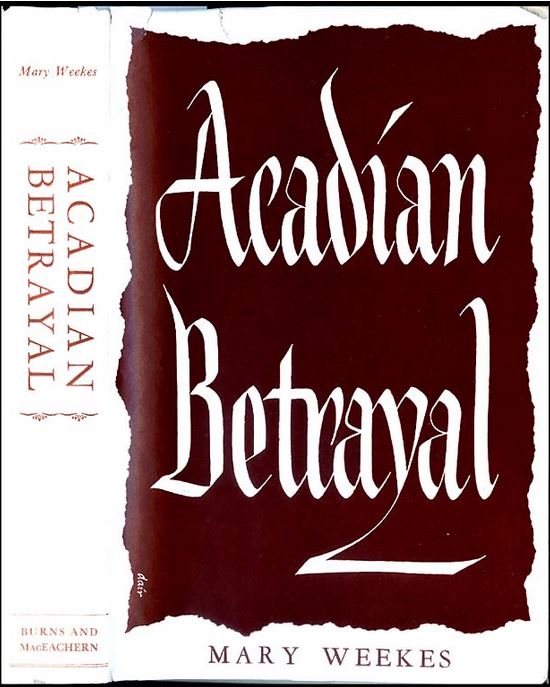
One again, I am returning to the story of The Pembroke.    In an earlier post (October 2010), I wrote  about the ancestors of Edith Mylott née Glode who in 1755 were exiled from Annapolis Royal aboard The Pembroke.  At that time, I didn't include the fact that an ancestor of Rivets, Prudent Robichaud, was also aboard that same vessel as well as others.  The story of The Pembroke is a true hardship story and probably one that historians will likely never know in detail.  The tragedy of The Pembroke was the basis of fiction by Mary L Weekes. 

A fictionalize story of The Pembroke can be read in Acadian Betrayal.  It use to be available on the internet.  If you cannot find a digital copy, it sometimes appears for sale on Ebay - but I suspect it wouldn't hold your interest for too long.  It is a typical melodrama.

The story of The Pembroke is a subplot in the tragedy of the Acadian people who were ousted, expelled, excised from the area around the Bay of Fundy from September through December 1755 by New England colonials under the authority of Governor Charles Lawrence and William Shirley, colonial governor of Massachusetts.  Over 7000 Acadian people were dispersed into small ships and sent to colonies along the North Atlantic seaboard and Haiti.  Some ships sank at sea, some were refused permission to dock and passengers remained without food and sanitary conditions in the ships while disease took over.  One ship, The Pembroke, was the exception. Its Acadian passengers overtook the crew and commandeered the ship across the Bay of Fundy to St John in present day New Brunswick.  On board that ship, were not only the Guilbault ancestors of Edith Glode and her sons, there also were the Robichaud, Melanson and Belliveau ancestors of Claire, Albert and Raymond Rivet of Cohoes, New York.  According to the article written by Paul Delaney on Acadian Ancestral Home, the probable leader of the Acadians on The Pembroke was Charles Belliveau. He is also the great great great great great grandfather of Claire, Al and Ray Rivet!!!


After bringing The Pembroke into the mouth of the St John's River, the Acadians were discovered by the English provoking an engagement, firing of arms, taking of English prisoners and ultimately burning The Pembroke so it could not be used against them.  Subsequently, the Acadians made their way to present day Fredericton, New Brunswick, then a French settlement called Saint Anne des Pays Bas where they wintered enduring malnutrition and exposure to the harsh environment.  The Rivet ancestor, Prudent Robichaud, quite elderly, died sometime during this struggle and somewhere along the Saint John River.  It is believed the Acadians including Charles Belliveau,  Charles Melanson, and their families made their way north via canoe on the St John's River through Grand Falls (Grand Sault) to present day Edmunston regions and then onto the Madawaska River to Lac Temiscouata (present day Quebec). The route continued from Lac Temiscouata overland and via waterways to Trois Pistoles on the south shore of the Saint Lawrence River concluding in Ville Quebec.  


Unfortunately, Charles Belliveau and Charles Melanson, like many of the Guilbault family, are believed to have succumbed to smallpox in 1758 and 1757, respectively, after completing their harrowing escape.

Below, the St John River near Fredericton, New Brunswick, Canada


Below is a recap of the stories written about Acadians in this blog so far.  This list includes some early posts that may not have been well researched but I am reviewing them for accuracy and hope they will "make the cut"!

Monday, August 25, 2014

For my Wills Cousin's Granddaughter - Paul Benoit, an Acadian in Our Beauvais-Bissonnette Family Tree

I have been writing about my travels this month in the land of Acadia.  A few months ago I purchased a children's book titled Evangeline for Children by Alice Couvillon and Elizabeth Moore with the intention of sharing Longfellow's epic with the children in the family who have at least one Acadian ancestor.


So my first victim is entering 2nd grade in primary school next week.  I am going to try this book out on her.

Second grader at the County Fair with  Painted Face

This second grader has Acadian ancestors in her Beauvais and Bissonnette line.  I am posting her line so other Bissonnette/Bisnett and Beauvais/Bova from Cohoes and Waterford who descended from Celena Beauvais and/or her father Solyme Beauvais may also know how they have an Acadian great grand ancestor.

So if you are a Wills or Bissonnette or Bisnett, start from Celena Beauvais who married Joseph Bissonnette.  If you are a Beauvais or Bova, start from Solyme Beauvais and go back in time to Paul Benoit:

Living daughter (2nd Grader) of


Living Female, who is the daughter of


Living Female, who is the daughter of


William Robert "Bob" Wills 1923-2007, who was the son of


Elizabeth Bissonnette 1880-1936, who was the daughter of


Celena Beauvais 1850-1942, who was the daughter of


Solyme Beauvais 1821-1902, who was the son of


Genevieve Benoit 1799-1832, who was the daughter of


Paul Benoit 1751-1831
who was just four years old when the events in this story of Evangeline occurred.
He probably experienced the Acadian Deportation as a small child.
He was the son of


Geoffroy Benoit 1716-1769
He and his wife were exiled to Lancaster in the Massachusetts Colony
where they lived until they were able to move to Quebec.
He was the son of


Claude Benoit 1686-1743,
he was the son of


Martin Benoit 1643-1714.
Martin was born in France and came to Acadia to start a life with his wife, Marie in the spring of 1671 aboard l'Oranger.


Children's Area at the LeBlanc Reunion
CMA 2014


Below is a recap of the stories written about Acadians in this blog so far.  This list includes some early posts that may not have been well researched but I am reviewing them for accuracy and hope they will "make the cut"!

Sunday, August 24, 2014

We - and our flags - are all the same


Thinking about people, flags, and symbols...
I have a full time job working in the Bronx, New York City usually interacting with people of many different cultures, religions and languages.  My ancestors who migrated from Quebec to New York for jobs and work really do not seem much different than the fathers and mothers I meet everyday at my work.  They are struggling, often working several jobs and want their children to get a good education.  While living and working in New York City, I noticed how similar the Acadian Flag and the flag of Puerto Rico are...the lone star set in blue with red and white stripes. Here's photos of a PR day parade in NYC. The more I look at the photos, the more the celebrants look the same: colors, faces, children and fun!  


And here are photos I took  at the Acadian Tintamarre parade held in Madawaska, Maine on 15 August 2014:


The happy faces are the same in both NYC and Madawaska.  Both flags use the same colors and the white star on the blue background.  

When they're waved it's hard to tell the difference!


Below is a recap of the stories written about Acadians in this blog so far.  This list includes some early posts that may not have been well researched but I am reviewing them for accuracy and hope they will "make the cut"!

Saturday, August 23, 2014

Remembering Acadian Ancestors in Rivet, Mylott and Wills-Beauvais Families

If you are a Rivet, Mylott, Beauvais, Bissonnette, St Hilaire, or Wills identified on the pages of FrancoAmerican Gravy,  you do not have an Acadian name but you do have Acadian ancestors!! All these families have Acadian great grandmothers who were exiled to Quebec at the the time of the Acadian Deportation.  These grandmothers and great grandmothers married into Quebec families and gradually assimilated Quebec customs. Then during the great industrialization of New York and New England, our families came south, assimilating again into the American mainstream. Most in our families lost our ability to use French.

I took a three week journey to remember these Acadian Ancestors and grasp their tragedy, their sorrow and perhaps some of their happiness too.

August 23, 2014 and I have just returned from  a three week journey through Quebec, Maine, New Brunswick and upstate New York to attend the Acadian World Congress in a part of the world I am not familiar. Here is the map and you can try to identify exactly where this land fits into North America.  Although, this area is not the original Acadia, many descendants now live in this area where the Acadian culture, cuisine, pride and French language remain strong and vibrant.


There's beautiful landscapes in the St John's River Valley, Passamaquoddy Bay, the Saguenay River Gorge, and the great St Lawrence.  The days were never terribly hot and the evenings were cool with striking sunsets.  People were always friendly.  Sometimes we struggled through the French and English barrier with smiles and laughs. Of course there's lot of wildlife - loons, eagles, moose, with whale and beaver lodge sightings. The blueberries were in season: blueberries and salmon, blueberries and crepes, lots of fresh blueberries, throughout the trip.  My trip was planned to remember Acadian ancestors and even though I have never identified myself as an Acadian and am totally assimilated into American culture, it was important and poignant. 

During the trip I kept a copy of John Mack Faragher's A Great and Noble Scheme (2005:W.W. Norton & Company) which was an easy introduction to the story of the Acadian people and the consequences of living  in a place and time among three warring states - the Micmac First Peoples, France and England.


When "Le Grand Derangement"  began in September 1755 and ended in December 1755, over 7000 Acadian people were dispersed into ships, scattered throughout the British colonies on the eastern seaboard and some French colonies such as Saint Dominigue (present day Haiti).  Exiled from their homeland, many never returned to Acadia. Thousands of other Acadians fled to surrounding territories in what in now northern Maine, Prince Edward Island and New Brunswick.

I highly recommend all members of our family become aware of their Acadian ancestors and their story. Contact me at FrancoAmericanGray@gmail.com.


Below is a recap of the stories written about Acadians in this blog so far.  This list includes some early posts that may not have been well researched but I am reviewing them for accuracy and hope they will "make the cut"!

Tuesday, August 12, 2014

To the World Acadian Congress via St Croix Island


FrancoAmerican Gravy is planning to be at the Acadian World Congress 2014 in a few days.  In anticipation of sharing Acadian history with family and cousins it seems appropriate to start at the very beginning of the Acadian experience in North America. The beginning was in 1604 on a small island in the Saint Croix River presentably sitting on the boundary between Maine and New Brunswick.  Stopping at an observation park along the eastern shore of the Saint Croix River in the early evening, we were the only people to read the interpretive signs and stare west into the setting sun for a view of the island where almost half of the 79 Frenchman died of scurvy during the winter of 1604-1605.


L'Ile St Croix from New Brunswick

Scurvy was a common cause of morbidity and mortality among sailors and it wasn't until the 1930s that a definite connection between the lack of Vitamin C in fresh fruits and vegetables and scurvy was firmly established.  James Lind in 1793 conducted research demonstrating a reduction of scurvy if one consumed citrus fruits.
"JamesLind".
Licensed under
Public domain via Wikimedia Commons 

Scurvy is not a thing pretty and imagining a sailors's slow death from scurvy could not be anything other than agonizing as a he developed malaise, lethargy, ulcers, tender gums, and bodily wounds bleeding out finally resulting in his death.

Scurvy Manifestations copyright NEJM


The settlement was a failure but it was also the impetus to move the enterprise to Port Royal where a new and more thoroughly planned habitation could be planned. In Port Royal, the Acadian ancestors of the Rivets (Mireault, Robichaud, Bourgeois, Lord, Bourg, LeBlanc, Dugas, Melanson and more), the Mylotts (Guilabult, Girouard, Therriot, Bourg, Landry, LeBorgne, Delatour ) and Beauvais (Babin, Benoit, Bourg, Hebert, Comeau, Richard, Melanson and more) would come to flourish.

The Saint Croix River flows from a chain of lakes in northeastern Maine called the Chiputneticook Lakes.  The largest is East Grand Lake where we have been resting for a week mid way through our travels in Quebec, the Gaspe Peninsula and the Acadian Peninsula.  East Grand Lake is one of my favorite lakes and knowing its waters are the actual headwaters of the Saint Croix River and eventually empty into Passamaquoddy Bay make it special.  Here are some photos of the August sunsets on the waters of East Grand Lake.


Below is a recap of the stories written about Acadians in this blog so far.  This list includes some early posts that may not have been well researched but I am reviewing them for accuracy and hope they will "make the cut"!

Saturday, October 23, 2010

Acadians in the Rivet Family who lived, died and were born during the "Grand Derangement"

There isn't an exact number of Acadian people who were expelled by the British and the New England regiments between 1755 and 1764.  Estimates range from 7,000 to 10,000 people.

I have tried to compile a list of those ancestors of the "Rivet Family of Cohoes" who endured the Grand Deportation of Acadians from present day Nova Scotia.  With the exception of those Rivet ancestors who were on board the ship named The Pembroke, all these Rivet ancestors were exiled to New England - Connecticut and Massachusetts.  The story of the Acadians and their dispersal across areas of the Atlantic is briefly told here.

One of the souls who did not survive the ordeal was the elderly Prudent Robichaud who was put upon The Pembroke. Interestingly and sadly, Prudent Robichaud may have died despondent and dispirited.  He was a key community leader who spoke both French and English and found a role keeping peace between the English rule and the French agricultural community.  A now broken link from the University of Moncton Acadian History site offered a brief biography of this man....

Prudent Robichaud (c. 1669-c. 1756)
"Prudent Robichaud, probably born in Port-Royal, was chosen in 1710 as the spokesman for the community, which was then under British rule. After 1720, he was an Acadian delegate who negotiated with the British administration. During that time, he was also one of the main suppliers for the British garrison of Port-Royal (then called Annapolis Royal), providing wood and food to the troops. In 1727, he was appointed justice of the peace for Annapolis Royal by British Lieutenant Governor Lawrence Armstrong and in 1733, Lawrence called upon him to collect the moneys that were to be paid to the British Crown. For over thirty years Robichaud worked with the British administration, but that would not save him from the Deportation. Despite his advanced age, he was embarked on the Pembroke with many other Acadians in 1755. "


Prudent Robichaud was on board the same ship with the ancestors of Arthur Mylott, the Guilbault Family, as noted in an earlier entry on this blog.  The history of The Pembroke on Acadian Ancestral Home states Prudent probably died in the summer of 1756 along the St. John's River in present day New Brunswick, Canada.  


These ancestors endured the deportation and were exiled:

  • Joseph Amireault 1689-1774 and Marguerite Lord 1698-1788 to Connecticut Colony.
  • Pierre Amireault 1722-1796 and Anne Robichaud 1739-1813 to Connecticut Colony.
  • Charles Belliveau, 1697-1758, widower, navigator. Escaped on The Pembroke, died of smallpox in Quebec.
  • Charles Belliveau 1731-1796 and Osithe Dugas 1734-1820 exiled to Massachusetts.
  • Claude Bourgeois 1695-1760 and Marie LeBlanc 1706-1781 exiled to Massachusetts.
  • Germain Bourgeois 1749-1820, child of Claude and Marie LeBlanc listed above, exiled to Massachusetts.
  • Marie Madeleine Bourgeois 1704-1770, widow of Pierre Robichaud exiled to Massachusetts.
  • Claude Dugas 1710-1792 and Marie Josephe Melancon 1713-1793 exiled to Massachusetts.
  • Pierre Dupuis 1714-1790 and Anastasie Bourgeois 1730-1793 exiled to Massachusetts.
  • Louis Fontaine 1707-1787 and Marie Madeleine Roy 1701-1758 exiled to Connecticut.
  • Jean Baptiste Jeanson 1715-1785 and Marie Josephte/Marie Jeanne Lord 1718-1796 exiled to Connecticut.
  • Jean Baptiste Landry 1716-1770 and Marie Marguerite Daigle 1724-1799 exiled to Massachusetts.
  • Pierre Lanoue 1738-1820, widower of Anne Belliveau, exiled to Connecticut.
  • Pierre Lanoue 1738-1820 and Marie Josephe Dugas 1721-1807 exiled to Connecticut.
  • Francois LeBlanc 1712-1790 and Marguerite Boudrot 1698- after 1767 exiled to Massachusetts.
  • Francois LeBlanc 1712-1790 and Isabelle Dugas 1721-1807 exiled to Massachusetts.
  • Joseph LeBlanc 1741-1812 and Marie Madeleine Dugas 1732-1790 exiled to Massachusetts.
  • Louis Lord 1722-1781 and Luce Josephe Fontaine 1734-1805 exiled to Connecticut.
  • Madeleine Melanson the widow of Charles Belliveau, born about 1677, escaped on The Pembroke.
  • Charles Melanson 1675-1757 widower of Anne Bourg, died in Quebec.
  • Charles Melanson (~1701- ?) may have died before, during or in exile in Connecticut with his spouse Anne Granger (1705- after 1763) She was exiled to Connecticut.
  • Amable Melanson 1744-1826 exiled to Connecticut.
  • Prudent Robichaud born 1669, widower of Henrietta Pettipas, escaped on The Pembroke, died along the St John’s River near present day Fredericton, New Brunswick. 
  • Prudent Robichaud, widower of Marie Francoise Bourgeois. Disposition Unknown.
  • Dominque Robichaud 1723-1791 and Marguerite Forest-Troye 1725-1795 exiled to Connecticut.
  • Marie Madeleine Bourgeois 1704-1770, widow of Pierre Robichaud exiled to Massachusetts.

These ancestors were born in exile:
  • Jean Amireault 1756-1845 born in Connecticut, married to...
  • Marie Anne Dupuis 1762-1833 born in Massachusetts.
  • Marguerite Jeanson 1760-1817 born in Connecticut.
  • Marguerite Lanoue 1771-1826 born in Connecticut.
  • John Baptiste Lord dit Talaron 1761-1817 born in Connecticut, married to...
  • Luce Robichaud 1764-1847 born in Connecticut.
  • Ludivine Elizabeth Belliveau 1757-1844 born in Massachsetts.


Below is a recap of the stories written about Acadians in this blog so far.  This list includes some early posts that may not have been well researched but I am reviewing them for accuracy and hope they will "make the cut"!