Showing posts with label Wills. Show all posts

Monday, August 25, 2014

For my Wills Cousin's Granddaughter - Paul Benoit, an Acadian in Our Beauvais-Bissonnette Family Tree

I have been writing about my travels this month in the land of Acadia.  A few months ago I purchased a children's book titled Evangeline for Children by Alice Couvillon and Elizabeth Moore with the intention of sharing Longfellow's epic with the children in the family who have at least one Acadian ancestor.


So my first victim is entering 2nd grade in primary school next week.  I am going to try this book out on her.

Second grader at the County Fair with  Painted Face

This second grader has Acadian ancestors in her Beauvais and Bissonnette line.  I am posting her line so other Bissonnette/Bisnett and Beauvais/Bova from Cohoes and Waterford who descended from Celena Beauvais and/or her father Solyme Beauvais may also know how they have an Acadian great grand ancestor.

So if you are a Wills or Bissonnette or Bisnett, start from Celena Beauvais who married Joseph Bissonnette.  If you are a Beauvais or Bova, start from Solyme Beauvais and go back in time to Paul Benoit:

Living daughter (2nd Grader) of


Living Female, who is the daughter of


Living Female, who is the daughter of


William Robert "Bob" Wills 1923-2007, who was the son of


Elizabeth Bissonnette 1880-1936, who was the daughter of


Celena Beauvais 1850-1942, who was the daughter of


Solyme Beauvais 1821-1902, who was the son of


Genevieve Benoit 1799-1832, who was the daughter of


Paul Benoit 1751-1831
who was just four years old when the events in this story of Evangeline occurred.
He probably experienced the Acadian Deportation as a small child.
He was the son of


Geoffroy Benoit 1716-1769
He and his wife were exiled to Lancaster in the Massachusetts Colony
where they lived until they were able to move to Quebec.
He was the son of


Claude Benoit 1686-1743,
he was the son of


Martin Benoit 1643-1714.
Martin was born in France and came to Acadia to start a life with his wife, Marie in the spring of 1671 aboard l'Oranger.


Children's Area at the LeBlanc Reunion
CMA 2014


Below is a recap of the stories written about Acadians in this blog so far.  This list includes some early posts that may not have been well researched but I am reviewing them for accuracy and hope they will "make the cut"!

Saturday, March 31, 2012

More Mapping the Route: Québec to Cohoes, Waterford

I am fascinated when I think about how French speaking Quebecers made their way to the Cohoes area in the 19th century. Essentially all the ancestors on this blog: Mylott, Allard, Glode, Rivet, Beauvais, Bissonnette, Guertin (Yetto), Hamel, Lord, LaCasse, Kagle, Guay and St. Hilaire made their way from somewhere in Quebec to the Cohoes - Waterford - Troy area. The powerful waters of the Mohawk River falling over the Cohoes Cataract and the thoroughfare the Hudson River provided made Cohoes and Troy an industrial hub where textiles, iron axes, and brick masonry were manufactured and iron foundries flourished.  Cohoes offered employment - steady employment to French Quebecers whose large families exhausted land resources.  During the 19th century these families poured into mill towns of New England and upstate New York.

Many of the ancestors families of this blog came in similar fashion and similar times and others came in somewhat unique circumstances.  Let's take a look at some of the families, the ancestors and the routes they may have traveled to upstate New York.

TRAIN: Solyme Beauvais and Adele Guay left St Cesaire, Rouville,Quebec and arrived in Cohoes between 1862-1870.

TRAIN: Moise Bissonnette and Julia Kagle came from St Jean sur Richelieu, Quebec and arrived in Cohoes between 1844-1849.

TRAIN: Maxim Rivet and Marie Lord left St Jacques L'Achigan, Quebec and arrived in Cohoes about 1895.

TRAIN: Dedace LaCasse and Marie Louise Amireault came from Joliette, Quebec and arrived in Waterford  about 1898.

TRAIN: Jean Baptiste Guertin, later John B Yetto, baptized in St Hyacinth, Quebec in 1828 was living in Troy by 1860.

TRAIN: Louis St. Hilaire and Elisa Paré from St Patrice de Sherrington/Napierville, Quebec went to Cohoes about 1892.

TRAIN: The parents of Malvina Hamel, the stepmother who raised Claire, Al and Ray Rivet, were Joseph Hamel and Charlotte Josephine Lambert who came from St Cesaire, Rouville, Quebec to Cohoes between 1867-1868.


and the English speaking ancestor....
TRAIN: After emigrating form Cornwall, John Albert Berryman Wills and his wife, Anne Reed, made their way from the area of the Huntington Copper Mine in Bolton, near Lake Memphremagog, Quebec to Port Henry on Lake Champlain between 1868-1870.  It is likely the first part our their journey was on the Canada Pacific Railroad from Newport, Vermont to St Albans, then continuing on the Rutland & Burlington to some port on the eastern shore of Lake Champlain, Vergennes, where they ferried to Westport and Port Henry in Essex County.


Depending on the time period, the trip on trains could be grueling or very grueling!  Quebec families who flooded New Hampshire, Massachusetts, Connecticut and Maine, often traveled the Grand Trunk Railway.  Those who came to Cohoes and upstate New York in the 1850s and 1860s need to negotiate a different route, one that was indirect and perhaps more arduous due to possible transfers in Burlington Vermont, again in Rutland Vermont, Whitehall NY, and Schenectady or Saratoga NY depending on the time period.

Online maps are available that can clarify passenger train routes which disappeared long ago or were taken over by D&H.  Below are just a few from 1849  demonstrating the lines between Rutland, Whitehall and Saratoga.  From Rutland it was possible to make a connection to the Saratoga & Washington Line running to Whitehall, Saratoga Springs, Ballston Spa and eventually Cohoes OR the Troy-Rensselaer & Rutland Line that ran from Castleton, Vermont through Rupert, Cambridge, White Creek, Eagle Bridge, Hoosick to Lansingburg.

 1849 railroad map


Below is another map published in a book describing the proposed Lebanon Springs Railroad 1866


Describes railroad routes to Montreal


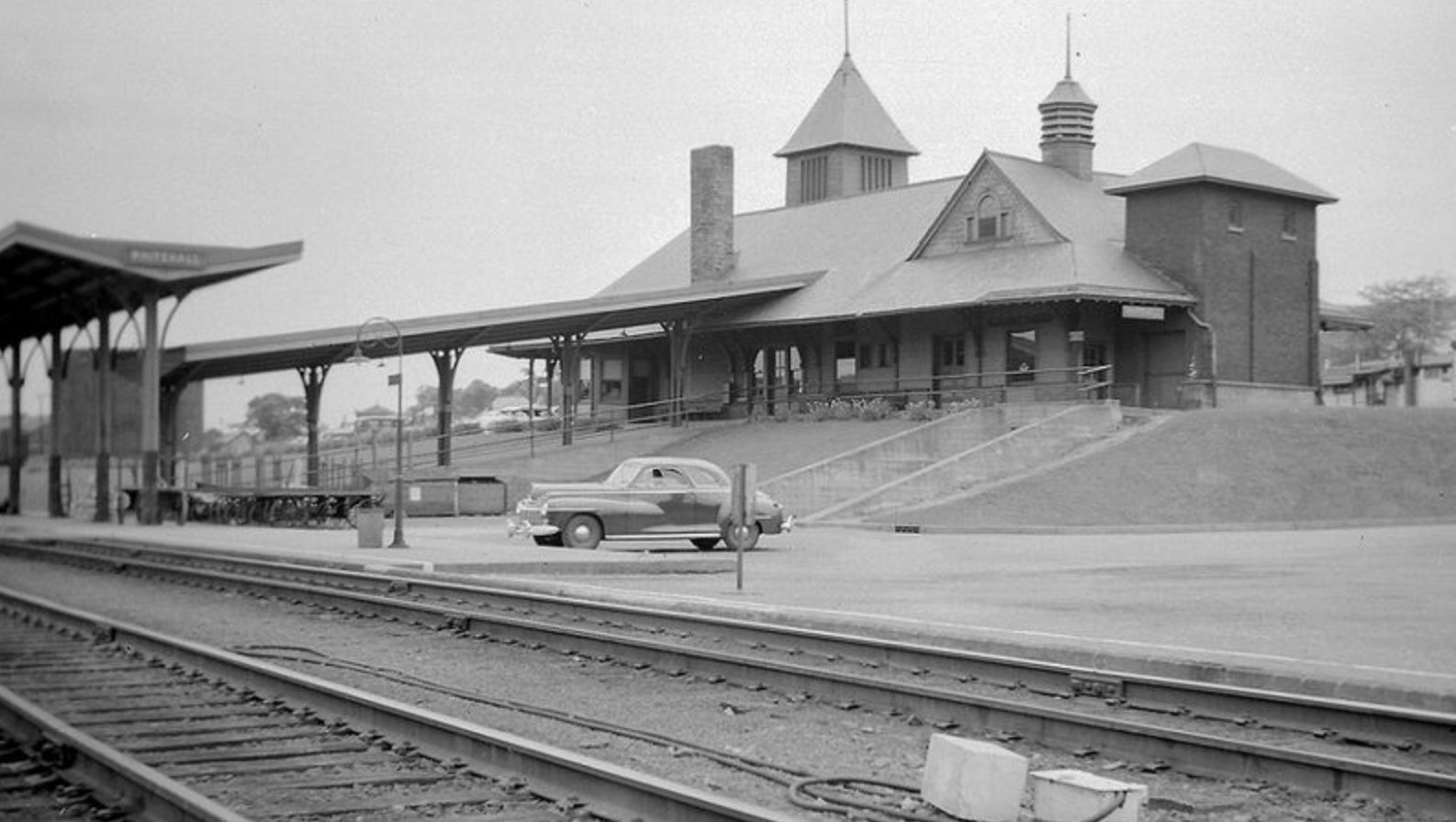
The Whitehall Train Station

The Whitehall Train station many years after our ancestors passed through

AND THEN THERE WERE THE CANALERS....


CANAL BOAT: Ancestors of Alex Glode and Angeline Allard, including Paquet, Allard, Duvernay, Beaudry, and Lalonde moved across the northern border to Champlain NY in the first half of the 19th century probably to farm the level lands there. Eventually, they became canalers along the Champlain Canal from Chazy to Whitehall and to Waterford, NY where they ultimately settled between 1890 and 1900.

CANAL BOAT: Robert Mylott, (Milot) baptized in 1832 in Vercheres, Quebec made his way from the Richelieu Valley, possibly St Jacques-le-Mineur Quebec to Whitehall NY in the 1840s. He was a very young man at the time. How he exactly made this trip we will never know although in an earlier post I made a guess. His grandson, Benjamin Mylott, a canaler eventually came to Waterford where he raised his family.


Monday, January 2, 2012

Convergence and Confluence

If you follow this blog you know it is dedicated to three individuals, Arthur Mylott, Al Rivet and Dorothy Wills. When expanded, it traces four French Canadian Families: Mylott or Millot dit Champagne, Rivet, and Bissonnette and Beauvais families.  An interesting fact comes to light as the family tree expands backwards to the 17th century, Arthur and Al , Arthur and Dorothy, Al and Dorothy as well as Al and Dorothy and Arthur together,  are all cousins several times over!  In other words, they share ancestors or  "Founder" couples who are relatively recent - in the past 12 generations - from old Québec and Acadia.  Call it "convergence".  It is an interesting fact how individuals who live in close geographical proximity, share the same language, economy, religion and customs are more likely to intermarry and develop complex extended families.  It is just a fact of life in closed social groups and one that is changing as complex communication networks (Facebook, internet) and international travel are the new "norm".  As diversity increases, no one is surprised with wide cultural and genetic mixtures.  I can still remember my surprise meeting a mother from Yemen, dressed in traditional hijab and abaya, who communicated to me in Spanish.  Her husband was Cuban and she couldn't speak English.  At my work it is not at all uncommon for a child to have grandparents from Jamaica, west Africa, Latino America, Italy or Ireland.

CONFLUENCE
French speaking Québec families shared the Catholic religion and an agricultural livelihood. Marriages were made between 2nd and 3rd cousins with dispensations from Catholic bishops. Several brothers often married several sisters. They seldom entered into marital relationships with English, Scotch or Irish after the English took control of Québec after the conquest.  In the US, we call that event the French and Indian War.  The French Québec marriage pool was initially limited to the finite number of French families who lived in villages along the St Laurent River.  Like the honeycombed structure of bone matix, close interrelationships solidified Québec society together.

A CLOSER LOOK AT CONVERGENCE
So let's consider instances where the family of Al Rivet, Arthur Mylott and Dorothy Wills converged.  We will look at a few of the most recent ancestors common to all three families.  To do this let's return to the post of September 18, 2011 about Our Forefathers in the Carignan-Salieres Regiment.  About midway through the story, it states Louis Robert and Nicolas Sylvestre dit Champagne were members of the Carignan-Salieres Regiment and common forefathers to three of the five families the story focused on.
For the sake of clarity, let's take a closer look at Nicolas Sylvestre dit Champagne.  Nicolas was born in Pont sur Seine, Champagne, France and married Marie Barbe Neveu on August 20th, 1667 in Québec.  The line of their daughter Marie Anne Sylvestre, continued to both Arthur Mylott and Al Rivet making them 8th cousins once removed.  Dorothy Wills, through her mother Elizabeth Bissonnette's line, descended from Nicolas Sylvestre, the brother of Marie Anne and youngest child of Nicolas Sylvestre and Marie Barbe Neveu, making Dorothy a 7th cousin once removed of Arthur Mylott and also a 7th cousin twice removed from Al Rivet!  Interestingly, Al Rivet is a cousin to himself - Nicolas Sylvestre and Marie Barbe Neveu are his grandparents via his paternal grandmother and his maternal grandfather!  Louis Riel, the leader of the Métis Rebellion in Manitoba, also could have claimed Sylvestre and Neveu as "grancestors".
Another Quebec couple, Jacques Lussier (1646-1712) and Catherine Clerice (1653-1715) are common great "grancestors" of Arthur Mylott, Al Rivet and Dorothy Wills (and, by extension,  any of their siblings).

MORE INSTANCES of CONVERGENCE
According to my genealogical research, Al Rivet and Arthur Mylott have at least THIRTEEN cousin relationships, Arthur Mylott and Dorothy Wills have at least SIX cousin relationships, and Al Rivet and Dorothy Wills have FIFTEEN cousin relationships.  Additionally, there are at least EIGHT cousin relationships or eight common Quebec and Acadian founder couples that are shared by Arthur, Al and Dorothy!!

Any comments? Comments are most welcome and appreciated.