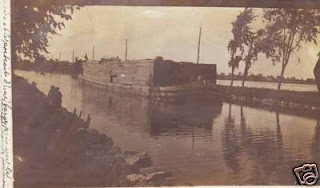
|
| Early 20th century postcard of Fort Lennox |
 |
Present Day site of Fort Lennox on Ile aux Noix
Parks Canada |
Joseph Payant dit St Onge is called the Admiral of Lake Champlain (L'Admiral du Lac Champlain) and he is a direct ancestor of many in Canada and the USA, including the Wills-Beauvais family of this blog. If a Bissonnette/Bisnett of Cohoes was your grandparent, great grandparent, etc (Joseph, Alfred, Elizabeth) then you are a descendant of Joseph Payant. Thousands of people can claim "Admiral Joe" their ancestor!
Our line (Wills) is simply this:
- Nine (9) Wills children (Celena, Julia, Anna, Johnny, Elizabeth, Dorothy, Etta, Larry, Robert) whose mother was
- Elizabeth Bissonnette (1880-1936) who married John Wills, and was the daughter of
- Celena Beauvais (1850-1942), the daughter
- Adele Guais dit Castonguais (abt 1824-?), the daughter of
- Marie Angelique Delmas (1792-1855), the daughter of
- Marie Louise Allaire (1768-?), the daughter of
- Marie Louise Payant dit St Onge (1747-?), daughter of
- Dominique Payant (1724- 1778), son of
- Joseph Payant dit St Onge (1700-1783), the "Admiral of Lake Champlain"
 |
| The early 20th century entrance to Fort Lennox |
To understand the role of Joseph Payant on Lake Champlain and also in the French and Indian War, it's necessary to know about his background. He was born in Québec City in 1700. His mother died when he was ten years old but his father, a shoemaker, quickly remarried. Joseph was not left motherless. As a young man he learned to pilot and navigate on the St Lawrence River. Married at 21, he had a wife, family, home on Rue St Flavian in Québec and a blacksmith shop where he worked in winters. In spring when the ice on the river opened up, Joseph kissed his wife and children "adieu" was off to the Champlain Valley where he piloted ships along the Richelieu and Champlain:
Fort Frederic, Ile aux Noix,
Fort Chambly and probably
Fort Carillon too. The ships, built in St Jean, carried troops and supplies from Montreal and Chambly to the forts south and back again. When the Swedish naturalist,
Pehr Kalm, traveled in Lake Champlain region, it was Joseph Payant who escorted him. It is said Joseph transported General Montcalm from Carillon to points north after Montcalm's victory becoming well acquainted. Later, one of Joseph's grandsons was named Montcalm in honor of the general. Dominique, Joseph's son and our ancestor, was listed as a sailor with his father on Lake Champlain and married Marie Louise Laporte in St Joseph's Church in Chambly. Their marriage contract stated Dominique owned land on Lake Champlain in the area across from Ile aux Noix close to where Lake Champlain enters the Richelieu River.
In the midst of the French and Indian War, after the
French abandoned Fort Frederic to the English, Joseph Payant continued to pilot a schooner with eight cannons named
La Vigilante on the waters of Champlain. Payant was not the commander of the French fleet on the lake, that honor was held by Joannis-Galand d'Olabaratz, a commissioned naval officer. The English fleet was commanded by Captain Joshua Loring. For several weeks that autumn, while Amherst was rebuilding and enlarging the fort at Crown Point the English and French fleets played deadly serious games of chase on the lake.
Russel Bellico on page 100 of
Sails and Steam in the Mountains (revised edition 2001: Purple Mountain Press) writes about a particular event on October 12th, 1759...
"On the first night, Loring with the brig and sloop had sailed past the three French sloops at Four Brothers Islands, commanded by Joannis Galand d'Olabaratz. The schooner La Vigilante , commanded by Joseph Payant St. Onge, was stationed further north on the lake near Grand Isle. At daybreak on October 12th, Loring observed the French schooner apparently moving toward the two British ships. The Vigilante fired and the Cumberland and Boscawen (the English boats) gave chase, whereupon the French schooner maneuvered into the shallow water between the Sisters Islands (Bixby and Young Island) on the west side of South Hero Island. The experienced French pilot (Payant) had drawn the British vessels into a trap, with both British ships running aground. The Boscawen got off the shoal easily but the Cumberland was forced to take eight canon and all the troops off to lighten the vessel. By the time the British were free of the shoal, the Vigilante was long gone."
After the British recovered they did force d'Olabaratz to scuttle and abandon three importance French vessels. Over nine days, the French naval crew hike overland back to the fort on Ile aux Noix where they met an infuriated commander Bourlamague. Bellico goes on to describe what happened next:
"La Vigilante, at the same time, had hidden in the lee of Isle La Motte. The old lake pilot (Payant) brought his vessel into Bourlamaque's headquarters on October 16 to the wonder of the garrison, whose men thought the ship had been captured."
The area where Payant set the trap is a blue shaded triangle on the Google map below....
and also here

For the winter and spring, the French maintained control of the fort at Ile aux Noix, while in Quebec, St Lawrence Valley and forts west, the French colony was being overwhelmed by the British. In spring, Amherst sent Robert Rogers and his rangers to raid Fort St. Jean and Fort Chambly on the Richelieu, the source of French supplies. In the summer of 1760, the naval war games on the lake resumed until finally in August the final actions occurred in the shallow waters around Ile aux Noix. The British forces under Brigadier General Haviland set up an offensive position on the shores southeast of Ile aux Noix erecting cannons and mortars. Bellico describes on the morning of August 17th, a terrible scene where English crew had their legs blown off and the captain died. Then there were more casualties. Robert Rogers dragged a howitzer and a cannon to the shore northwest of the island. The French ships, including the Vigilante were separated from the French fort. Cannons fired upon the remaining French fleet with Rogers pushing forward to prevent the Vigilante from reaching open waters eventually causing the Payant's schooner to run aground in the shallow waters. It signaled the end of the French in the Champlain Valley.
 |
Ile aux Noix in the middle of the Richelieu River
Just a few miles north of the the Québec-New York Border |
Joseph Payant dit St Onge survived the battles on Lake Champlain retiring to Chambly in the aftermath of the war. His children and grandchildren flourished in the Richelieu Valley and many of his descendants emigrated to the lands south of the lake he once bravely sailed and defended.
click on image to enlarge and read

 |
| The calm waters around Ile aux Noix, September 2010 |
Bibliography:
Joseph Payant dit Saintonge: THE ADMIRAL OF LAKE CHAMPLAIN. Manchester, New Hamphire: American Candian Genelaogogical Society. ACGS bulletin, #108, Volume 32, Number 2, 2006, ISSN 1076-3902.
Sails and Steam in the Mountains. Russell Bellico. Fleischmans, NY: Purple Mountain Press. 2001.
Journey's Taken. William Kane . Tempe, Arizona: Crownest Press. 2002.
Chroniques du Haut-Richelieu III, L'Admiral du Lac Champlain. Phillippe Demers. Montreal: G. Ducharme. 1929.
"Echos de la Nouvelle France. L'Admiral du Lac Champlain". Pierre Biron.