Showing posts with label LaCasse. Show all posts

Sunday, May 15, 2016

Spring Tomb Sweeping Day


Subject: neglected, dirty family tomstones.
Time: a Saturday morning in May.
Location: St Joseph's Catholic Cemetery, Waterford NY.
Weather: Sunny with thunderstorms in the forecast.
Invitees:  2 cousins, a wife and a friend.
Material: 1 gallon of D2, several spray bottles of H2O, soft brushes, a few rags, rubber gloves and a funnel which was forgotten.

First Specimen: Headstone of Ida Mailloux, first wife of Emile Rivet. It wasn't easy to make out the words and that wasn't just because they were in French. We took out our gloves and poured to D2 into spray bottles. Twenty minutes later we took those soft brushes and gently scrubbed. The fungus and grime of 100 years literally fell off!


Gloves are important


BEFORE
AFTER


Here's another before and after of the simple stone of Emile Rivet and his third wife, Malvina Hamel.


We are not certain where Marie Louise Lacasse, 2nd wife of Emile Rivet and mother of Claire, Albert & Ray, is buried in St. Joe's. There are several Lacasse headstones located in different sections.  We found one with quite a lot of fungus adhering to it and sprayed it with D2. We didn't scrub it but will try the "let it alone" method and we'll check it out in a few weeks to see if it cleaned itself.


While walking around, we came across another stone with an interesting inscription because it was another family who came from St Jacques de l'Achigan where Emile Rivet was born and baptized.  Seraphin Jean Vaine was born in St Jacques de l'Achigan in September 1841 and died in Cohoes in 1900.  It was quite a nice stone by St Joe's standards.


Lastly, we stopped to check on Aunt Claire and Uncle Walker Yetto and felt glad to see the dates for Aunt Claire were completed and inscribed.


Monday, September 15, 2014

Claudette, daughter of Gérard Lacasse. Rimouski, Qc. ARE YOU STILL READING???

Claudette, if you are still reading and checking this blog, please send an email to me at FrancoAmericanGravy@gmail.com.  I have been trying, unsuccessfully, to contact you since you commented on the post about our mutual grandaunt Marie Anne Lacasse in 2012 !!!  Merci!!

? ? ? ? ? ? ?


Tuesday, January 1, 2013

Lacasse Family in Northside, Waterford circa 1900


The Lacasse family are ancestors of the Rivet family of Cohoes

Dedace Lacasse, one of the younger sons in the family of Ephrème Cassé and Luce Desautels-Lapointe, was probably made a wanderer by virtue of his birth order. Without a plot of his own land to farm, he was consigned to be a day worker on the farms of others. 

Portrait of woman believed to be Lucie Lapointe-Desautels, the mother of Dedace Lacasse.


Dedace and his wife Marie Louise Mireault were both born in St Jacques de L'Achigan, Quebec - Dedace in 1844 , Marie Louise in 1849. The couple married in 1867 in the church of St Alphonse de Rodriques, Quebec. In the 1881 census of Canada, the family is in Terrebonne, Quebec. In the 1891 census, they are located in Joliette, Montcalm, Quebec.  Sometime around 1898, Dedace brought his family from Quebec to New York.  They came to Northside in Waterford in 1898 to work in or around the factory mills of Cohoes and Waterford.  In the United States Census of 1900, six family members are listed: Dedace, Marie Louise his wife, Marie Ann and Marie Louise his two daughters and Edmond (Edward) and Camille, his two sons.  Marie Ann will not marry remaining at home to care for her parents, especially her widowed mother.  Marie Lousie will eventually became the second wife of Paul Emile Rivet. Edmond, naturalized a US citizen in 1912 will marry in Cohoes but after he is widowed in 1926, he will return to Québec with his children. He marries again in Rimouski, Québec.  Camille Lacasse seems to have moved to New York City but returns to Cohoes to marry.  He and his bride return to New York and raise their family in Queens.  Another son, Joseph Lacasse, not listed in the 1900 census with his parents,  marries and remains in Cohoes to raise his family.


 The Lacasse Family living at 20 Cemetery Road, Northside Waterford

Note the error - Cammile is listed as a daughter instead of son 


On May 1, 1910 Marie Edna Ann Lacasse, daughter of Joseph Lacasse and Emma Marie Fortin, granddaughter of Dedace and Marie Louise Mireault was baptized in the "French" church,  St Ann's Roman Catholic Church in Northside, Waterford where the family members were communicants.  Dedace was listed as the parrain or godfather. Below are two photographs of St Anne's Church in Northside after it was converted to Waterford Wesleyan Church.


Readers unfamiliar with Northside, Waterford and Cohoes may inquire why Northside is called "Northside" when it is actually on the south side of the town of Waterford of which it is a part.  It is my understanding that the founding fathers of Cohoes always considered Northside a part of the Cohoes community even though Northside was officially in a different town and even a different county.  Cohoes is in Albany County and Northside-Waterford in Saratoga County.  Only the waters of the Mohawk River divide the communities of Cohoes and Waterford but an early bridge connected the communities.

So the family of Dedace Lacasse and Marie Louise Mireault expanded and their descendants quickly spread across North America and back to Quebec

Here is a sign of Northside's French Canadian Heritage!
A home in Northside, New York displays its Roots - a flag of Quebec and a US flag!

Part 2 to follow.....

Thursday, November 22, 2012

Marie Louise Lacasse


This is the funeral card of Marie Louise LaCasse Rivet, biological mother of Marie Claire Rivet, Joseph Albert Rivet and Raymond Dedace Rivet.  Marie Louise was born in Saint-Côme, Joliette, Québec and dies in Cohoes, NY, USA.  Thank you to the widow of  Uncle Ray Rivet for sharing this card.

Saturday, March 31, 2012

More Mapping the Route: Québec to Cohoes, Waterford

I am fascinated when I think about how French speaking Quebecers made their way to the Cohoes area in the 19th century. Essentially all the ancestors on this blog: Mylott, Allard, Glode, Rivet, Beauvais, Bissonnette, Guertin (Yetto), Hamel, Lord, LaCasse, Kagle, Guay and St. Hilaire made their way from somewhere in Quebec to the Cohoes - Waterford - Troy area. The powerful waters of the Mohawk River falling over the Cohoes Cataract and the thoroughfare the Hudson River provided made Cohoes and Troy an industrial hub where textiles, iron axes, and brick masonry were manufactured and iron foundries flourished.  Cohoes offered employment - steady employment to French Quebecers whose large families exhausted land resources.  During the 19th century these families poured into mill towns of New England and upstate New York.

Many of the ancestors families of this blog came in similar fashion and similar times and others came in somewhat unique circumstances.  Let's take a look at some of the families, the ancestors and the routes they may have traveled to upstate New York.

TRAIN: Solyme Beauvais and Adele Guay left St Cesaire, Rouville,Quebec and arrived in Cohoes between 1862-1870.

TRAIN: Moise Bissonnette and Julia Kagle came from St Jean sur Richelieu, Quebec and arrived in Cohoes between 1844-1849.

TRAIN: Maxim Rivet and Marie Lord left St Jacques L'Achigan, Quebec and arrived in Cohoes about 1895.

TRAIN: Dedace LaCasse and Marie Louise Amireault came from Joliette, Quebec and arrived in Waterford  about 1898.

TRAIN: Jean Baptiste Guertin, later John B Yetto, baptized in St Hyacinth, Quebec in 1828 was living in Troy by 1860.

TRAIN: Louis St. Hilaire and Elisa Paré from St Patrice de Sherrington/Napierville, Quebec went to Cohoes about 1892.

TRAIN: The parents of Malvina Hamel, the stepmother who raised Claire, Al and Ray Rivet, were Joseph Hamel and Charlotte Josephine Lambert who came from St Cesaire, Rouville, Quebec to Cohoes between 1867-1868.


and the English speaking ancestor....
TRAIN: After emigrating form Cornwall, John Albert Berryman Wills and his wife, Anne Reed, made their way from the area of the Huntington Copper Mine in Bolton, near Lake Memphremagog, Quebec to Port Henry on Lake Champlain between 1868-1870.  It is likely the first part our their journey was on the Canada Pacific Railroad from Newport, Vermont to St Albans, then continuing on the Rutland & Burlington to some port on the eastern shore of Lake Champlain, Vergennes, where they ferried to Westport and Port Henry in Essex County.


Depending on the time period, the trip on trains could be grueling or very grueling!  Quebec families who flooded New Hampshire, Massachusetts, Connecticut and Maine, often traveled the Grand Trunk Railway.  Those who came to Cohoes and upstate New York in the 1850s and 1860s need to negotiate a different route, one that was indirect and perhaps more arduous due to possible transfers in Burlington Vermont, again in Rutland Vermont, Whitehall NY, and Schenectady or Saratoga NY depending on the time period.

Online maps are available that can clarify passenger train routes which disappeared long ago or were taken over by D&H.  Below are just a few from 1849  demonstrating the lines between Rutland, Whitehall and Saratoga.  From Rutland it was possible to make a connection to the Saratoga & Washington Line running to Whitehall, Saratoga Springs, Ballston Spa and eventually Cohoes OR the Troy-Rensselaer & Rutland Line that ran from Castleton, Vermont through Rupert, Cambridge, White Creek, Eagle Bridge, Hoosick to Lansingburg.

 1849 railroad map


Below is another map published in a book describing the proposed Lebanon Springs Railroad 1866


Describes railroad routes to Montreal


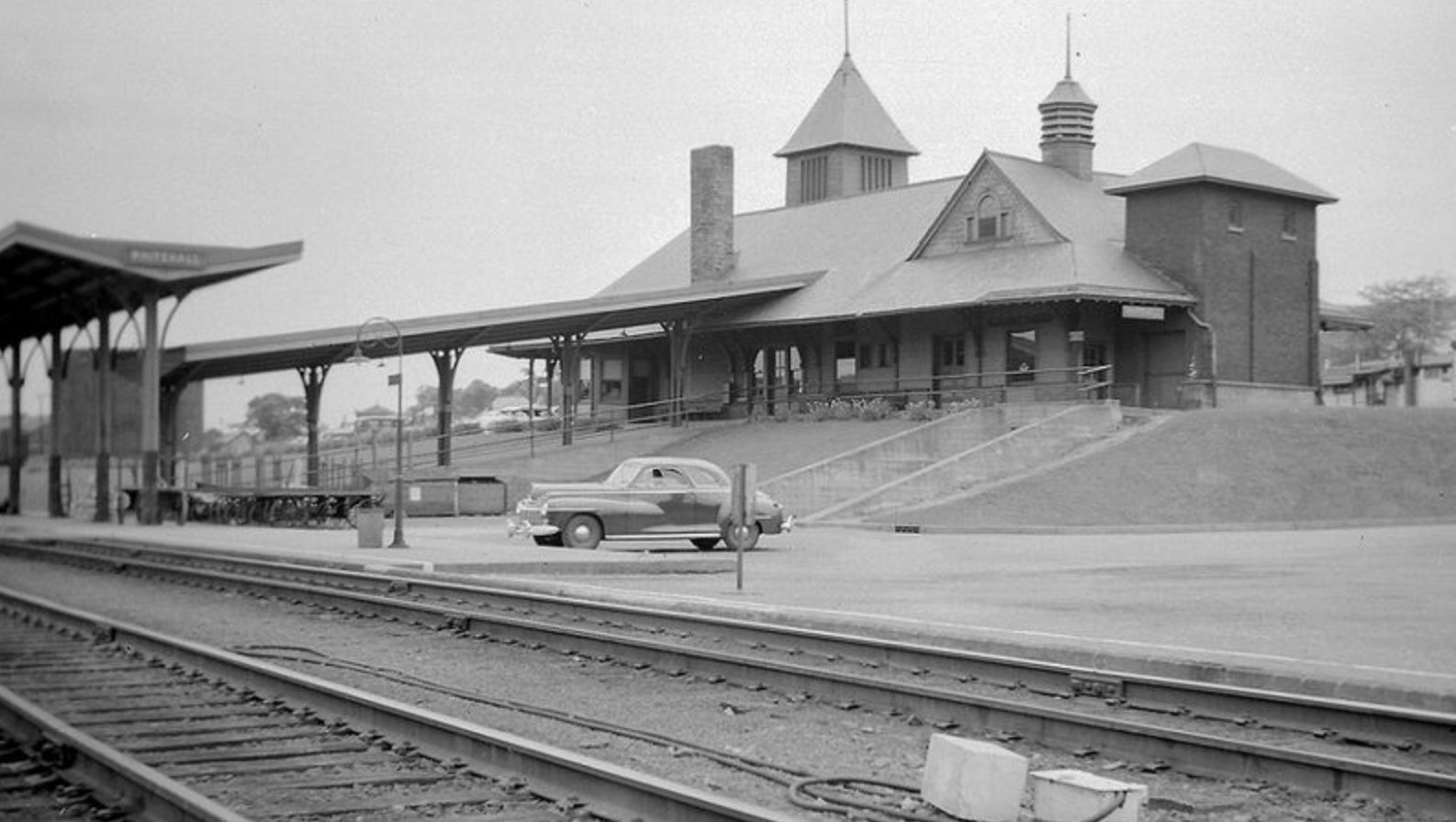
The Whitehall Train Station

The Whitehall Train station many years after our ancestors passed through

AND THEN THERE WERE THE CANALERS....


CANAL BOAT: Ancestors of Alex Glode and Angeline Allard, including Paquet, Allard, Duvernay, Beaudry, and Lalonde moved across the northern border to Champlain NY in the first half of the 19th century probably to farm the level lands there. Eventually, they became canalers along the Champlain Canal from Chazy to Whitehall and to Waterford, NY where they ultimately settled between 1890 and 1900.

CANAL BOAT: Robert Mylott, (Milot) baptized in 1832 in Vercheres, Quebec made his way from the Richelieu Valley, possibly St Jacques-le-Mineur Quebec to Whitehall NY in the 1840s. He was a very young man at the time. How he exactly made this trip we will never know although in an earlier post I made a guess. His grandson, Benjamin Mylott, a canaler eventually came to Waterford where he raised his family.


Sunday, September 18, 2011

Our Forefathers in the Carignan-Saliéres Regiment

If you are a descendant of a Mylott, a Glode, a Wills, a Beauvais, a Bissonnette, a Yetto, a St Hilaire or a Rivet on this site, you have an ancestor, at least one and probably more, who was in the Carignan-Salieres regiment.  In the mid 1660s, the Carignan-Salieres, veterans of the war with the Ottoman Empire, recruited new young men in France to be sent to the colony in Québec to protect the economic interests of the crown from the Iroquois nation.  The Iroquois, assisted and encouraged by the Dutch and later English interests in New England and New Amsterdam, picked off settlers in the French Colony - sometimes there were massacres of entire settlements in Montréal, called Ville Marie at that time.   The Champlain - Richelieu water corridor made raids into Quebec from New England a straight shot. The reverse was also true, French interests and allies used the same corridor to raid New York and New England.


Twelve hundred troops began arriving in June 1665 and were immediately put into service building Fort Sorel and Fort Ste Anne on Isle la Motte in Lake Champlain, now a part of Vermont. They also constructed Fort St Jean, Fort Ste Therese, and Fort St Louis (later Fort Chambly), all on the Richelieu River.

In January of 1666, the middle of winter, 300 under equipped troops were sent on a fool's mission into enemy territory by the Québec governor.  Traveling over a hundred miles, starving and hypothermic, they arrived in the Dutch settlement of Schenectady where the kind farmers fed and sheltered them.  They returned to Quebec having learned a brutal lesson that many upstate New Yorkers know too well.  Don't go into the north country without the proper equipment in the middle of January!

Scapulurs worn around one's neck.
Made by nuns for divine protection of the soldiers.
Displayed at the museum at Fort Chambly

Then in the fall of 1666, there was another expedition to Iroquois country.  Traveling form Québec, French soldiers reached their destination in the Mohawk Valley, west of Schenectady in two to three weeks.  This time, they were successful destroying several Mohawk villages.  Their efforts earned a peace between the Iroquois and French settlers after more than two decades of guerilla war by Iroquois.


After the peace was made in 1667, the regiments were disbanded and returned to France. However,  over 400 men choose to remain in Quebec, marry and start families there. We are the descendants of many of these soldiers.


 Below is a link to a gorgeously written document of the individual names of soldiers in the Carignan-Salieres Regiments.

A Listing of Soldiers in the Carignan-Salieres Regiment


The Bissonnette (Wills), Beauvais (Wills), Millot (Mylott), Glode-Poissant and Rivet-LaCasse families all have forefathers who served in the Carignan-Salieres Regiment. Although this list is a work in progress, it is a beginning to identify all Carignan-Salieres forefathers of the families on this site.  You may note in the list below, some individuals are in more than one family; they are ancestors in two families and some like Louis Robert and Nicolas Sylvestre, are ancestors in three families.  Here is the list thus far:

In the Glode-Poissant  family there are at least sixteen:
Louis Badillac dit Laplante
Jean Besset dit Brisetout
Jean Bricault dit Lamarche
Jean Brochu dit La Fontaine
Michel Brouillet dit Laviolette
Etienne Charles dit Lajeunesse
Pierre Couc dit LaFleur
Jean Delpé dit Pariseau
Julien Dumont dit LaFleur
Jean Gazaille dit St Germain
André Jarret dit de Beuregard
Jean Lavallée dit Petit Jean 
Pierre Menard dit Lapierre
Issac Paquet dit Lavallée
Louis Robert dit LaPommeraye
Jacques Têtu dit Larivière

In the Bissonnette family there are ten:
Bernard De Niger dit Sanssoucy
René Dumas dit Rencontre 
Antoine Dupré dit Rochefort
Antoine Emery dit Coderre
Aubin Lambert dit Champagne
Louis Robert dit LaPommeraye
Jean Robin dit Lapointe
Antoine Rousseau dit LaBonté
Jacques Suprenant dit Sanssoucy
Nicholas Sylvestre dit Champagne

In the Beauvais family there are eight:
Francois Biville dit Le Picard
Antoine Emery dit Coderre
Pierre Favreau dit Deslauriers
Nicolas Bonin dit St Martin
Julien Lord dit Montagne
Pierre Mésnard dit Xaintogne
Jacques Paviot dit LaPensée
Pierre Morin dit Champagne

In the Millot family there are three:
Francois Chagnon dit LaRose
Louis Robert dit LaPommeraye
Nicholas Sylvestre dit Champagne

In the Rivet and LaCasse families there are ten:
Antoine Casse dit Lacasse
Francois Chagnon dit LaRose
Bernard Delpêche dit Bellair
Antoine Emery dit Coderre
Pierre Favreau dit Deslauriers
Julien Lord dit Montagne
Piere Mageau dit Maisonseule
Pierre Mésnard dit Xaintonge
Eustache Prévost dit Lafleur
Nicolas Sylvestre dit Champagne


Friday, April 1, 2011

Marie Ann LaCassé, sister of Marie Louise and aunt of Claire, Al and Ray Rivet

Over one year ago, when I began this family history blog, I posted the image of four your women from Cohoes-Northside with a short explanation.  The names of two of the young women, Marie Louise Lacasse (1880-1923) and Marie Ann Lacasse (1878-1951) are written in Al Rivet's handwriting. Who the other two women are isn't known.  Here is the picture again....


Marie Louise Lacasse, standing on the right side, was the biological mother of Claire, Al and Ray Rivet. She died one and a half year after Ray was born.  Seated on the left is Marie Ann Lacasse who never married. As I commented, it appears Marie Ann looked after her mother, Marie Louise Mireault after her father, Dedace Lacasse died.   In the 1930 census, Marie Louise Mireault is 81 years old and residing in Northside.  Her daughter, Marie Ann Lacasse is 52 years old and resides with her.

As I write this I do not have a death certificate for Marie Louise Mireault.  I thought I had no further information about Marie Ann Lacasse, the spinster aunt of Claire, Al and Ray.  That was true until Ray Rivet's son sent me the memorial card for Marie Ann Lacasse.  I was somewhat surprised to see that she died back in Québec! Here's the card....

Most interesting was to see her face age but not otherwise change through the years.  Yet a question remained...why did Marie Ann return to Québec after the death of her mother?  and why Rimouski, Québec on the south side of the St. Lawrence where it begins to open up to the Gulf of St.Lawrence?  Well, it appears there was a brother, Edmond Lacasse, who lived and married in Cohoes but returned to Québec after the death of his first wife, Josephine Nolin.  Marie Ann Lacasse went to live out her years with Edmond and his family there.

Sunday, February 6, 2011

What I am Reading this Week: Gendered Passages by Yukari Takai OR Cohoes, New York versus Lowell, Massachusetts: Where would you go if you were crossing the 49th parallel looking for work?


The AMAZON description: Gendered Passages is the first full-length book devoted to the gendered analysis of the lives of French-Canadian migrants in early-twentieth-century Lowell, Massachusetts. It explores the ingenious and, at times, painful ways in which French-Canadian women, men, and children adjusted to the challenges of moving to, and settling in, that industrial city.  Yukari Takai uncovers the multitude of cross-border journeys of Lowell-bound French Canadians, the centrality of their family networks, and the ways in which the ideology of the family wage and the socioeconomic realities in Québec and New England shaped migrants lives on both sides of the border. Takai argues that French-Canadian husbands and wives, fathers and mothers, sons and daughters harboured complex interpersonal dynamics whereby differing and, at times, conflicting interests had to be negotiated in not necessarily equal terms, but in accordance with each members power and authority within the family and, by extension, larger society.
Drawing on extensive historical research including archival records, collections of oral histories, newspapers, and contemporary observations in both English and French, Gendered Passagescontributes to the re-reading of French-Canadian migration, which constitutes a fundamental part of North American history.


Cohoes, New York versus Lowell, Massachusetts:  Where would you go if you were crossing the 49th parallel looking for work?


In the first chapter, "To the Wrong Side of the Border", Takai describes the predominate regions of Québec sending emigrants to Lowell, Massachusetts in the early twentieth century were Lanaudière and  Maurice.  Although hardly a stressed point in Takai's thesis, I find it very interesting.  Lowell attracted French Canadians from Lanaudière and Maurice while, it would appear to me, Cohoes, smaller in size and manufacturing in the  early 20th century, was attracting French Canadians from Montérégie and parts of the Richelieu Valley.  Perhaps it was easier for Montérégie emigrants to make the trip directly south on the railroad into Cohoes.   The Guertin (Yetto)), Bissonnette, Beauvais, St. Hilaire, Chaput, all came from the Richelieu Valley.  The Rivet and the LaCasse families were exceptions.  Instead of heading to Lowell like the majority of emigrants from Joliette and Lanaudiére, Maxime Rivet and Dedace LaCasse with their respective wives and children, headed to Cohoes at the end of the 19th century.  Why did they come to Cohoes, New York instead of Lowell, Massachusetts?  It's a perplexing question and cannot be easily solved.  Did Maxime Rivet and/or Dedace LaCasse have prior relatives in Cohoes who wrote home and told them about the opportunities?  Were there active recruiters from Cohoes in Joliette seeking manpower and womanpower for the mills? Although the answer isn't apparent at this time, perhaps someday my research will answer this question.

New York Central Railroad Station in Cohoes: Where thousands of
French Canadians Disembarked to work in the Cohoes Textile Mills

Another view from the south of the New York Central Station


Meanwhile, reading Gendered Passages, encourages me to consider the crossing from Lanaudiére to Cohoes, instead of Lowell, may have more to do with the women.  Marie Lord and Marie Louise Mireault, respective wives of Maxime Rivet and Dedace LaCasse, may hold the key to solving this little mystery.

Related Links:

Yukari Takai: Author Profile


Saturday, October 30, 2010

Thinking of Ancestors on All Hallowed Eve

Below: Kinner or Wood Creek Cemetery, along Route 4 between Fort Anne and Whitehall, NY


Kinner or Wood Creek
Cemetery

Below: North Granville, NY

An interesting monument


John & Addie Mylott
North Granville NY

Below: East Pownal Cemetery, Vermont


John Wills and Annie Reed

Pownal, Vermont


Below: in St. Joseph's, Waterford, NY....