Showing posts with label Rivet. Show all posts

Sunday, August 21, 2016

Julien L'or dit Lamontagne: Act Inacheve (Unfinished Act)

Today I am reviewing some the the L'or or Lord lines in our families and found a void. A real void, that is, there is an empty space where there should be writing. A parish register from  "The Registers of St.Jean-Baptiste, Port Royal, 1702-1755 has the name "Julien L'or" written in the left hand margin but there is absolutely no writing!  For those researchers familiar with the style and format of the French Catholic parish registers of Quebec and Acadia, this is a glaring error.  For those reading this story who are unfamiliar with this format, I can only tell you that the dear Cure Charlemagne Cuvier may have tied one on the night before. The empty section occurs between the 17th of February and the 3rd of May, 1724. It must have been a long winter!


Who was Julien L'or anyway? Julien was an early habitant in Acadia, not one of the earliest but he arrived before 1675, probably from France and may have been in Quebec before his arrival in Acadia. Besides being the progenitor of the Lord family, he was a 6th great grandfather of Al, Claire and Ray Rivet and through a marriage also an ancestor of Dorothy Wills. He was born about 1652 and married Anne-Charlotte Girouard about 1675.  Julien and Anne-Charlotte had nine children and the Rivets descend from two of those children, Pierre L'or and Marguerite L'or. Al, Claire and Raymond Rivet's grandmother was Marie Lord, daughter of Solomon Lord, born in St. Jacques de l'Achigan in 1854.

Julien L'or and Anne-Charlotte lived and raised their family on the western side of the River Dauphin, slightly northwest and across the river from Port Royal. In  the 1686 census of Port Royal Julien and Anne-Charlotte are listed as 33 and 26 years old with 4 children: Alexandre 10, Jacques 8, Pierre 5, and Marie 1 year old.  Cattle and sheep are not enumerated on their entry. On this map, you can find their domain:


and the detail...


It is possible that Julien was buried in the cemetery of the church of St Jean Baptiste in Port Royal, present day Annapolis Royal, Nova Scotia. With a blank entry, who knows exactly what occurred to Julien when he died.  Could he have drown in the River Dauphin and his body never found?

In July, I had an opportunity to walk through the oldest section of the St. John Baptiste cemetery guided by Alan Melanson on the Acadian Ancestral Tour. Julien L'or's remains may have been close by and under our footsteps....even though he has a blank entry in the place where his burial should be recorded!


Here is the line from Claire, Al and Ray Rivet, siblings born in Cohoes NY between 1916 and 1922, who were the children of:
 Paul Emile Rivet 1880-1961, born in St Jacques de l'Achigan, son of 
  Marie Lord , 1854-1914, born in St Jacques de l'Achigan, daughter of
   Solomon Lord, 1827-1913, born in St Jacques de l'Achigan, son of
    Louis Thaddee Lord, 1784-1858, born in St Jacques de l'Achigan, son of
     Jean Baptiste Lord dit Talaron, born 1761 in exile in Connecticut Colony, son of
      Louis L'or, 1722-1781, born in Port Royal, Acadia, son of 
       Pierre L'or, 1682- 1738, born in Port Royal, son of
        Julien L'or dit Montagne and Anne-Charlotte Girouard


Friday, August 19, 2016

Acadian Family Update


Six years ago I started writing about the Acadian Ancestors in the three families I research most intensely - the Mylott family of Waterford & Whitehall New York, the Rivet family of Cohoes New York, and the Wills family of upstate New York, Cornwall and Quebec.  In the past six years I have learned a lot about them through reading & researching and getting help from a special lady, Lucie LeBlanc Consentino, who hosts the website Acadian Ancestral Home.  Thanks to Lucie and her sharing, I think I'm able to explain to others and to myself the story of these ancestors with some accuracy and confidence.  It is a big story and vast history involving Acadian families being pushed and pulled across the globe and throughout the English, French and Spanish colonies of the mid 18th century. For me personally, it is a history that brought the ancestors of the Rivets, Mylotts and Wills together 200 years before Al Rivet, Claire Rivet, Ray Rivet, Arthur Mylott, and Dorothy Wills came together in the working class neighborhoods of Cohoes and Waterford, New York.  For this reason, the story of the Acadians in my families will always be the centerpiece of my family's genealogy. Antoine Bourg and Antoinette Landry who married about 1642 and a founding couple of Acadia, are common ancestors of Al Rivet, Claire Rivet, Ray Rivet, Arthur Mylott and his siblings (Milo and Edgar), and Dorothy Wills and all her siblings (Celina, Julia, Anna, John, Elizabeth, Muriel Etta, Larry and Robert).  The Rivet family emigrating from St Jacques de l'Achigan and the environs of Joliette, Quebec certainly have an overwhelming number of Acadian ancestors who resettled in this areas after the exile.  Some Mylott and Rivet ancestors were thrust together on the journey and drama of "The Pembroke". Some Wills ancestors were exiled to the port of Boston where the dying words of our 6th great grandmother, Jeanne Hebert, were recorded by Timothy Hutchinson, a later governor of Massachusetts colony, in 1755.*

FrancoAmerican Gravy & Lucie LeBlanc Consentino
on tour July 2016
During July 2016, I was fortunate to be able to travel with Luce's Acadian Ancestral Tour for a week to historical sites, memorials, museums, churches, rivers, shores with Fundy tides that are a part of Acadian history. This included locations in present day New Brunswick, Prince Edward Island and Nova Scotia.  The bonus was traveling with 40+ Acadian cousins who are all lovers of genealogy and history - especially Acadian genealogy and history.  Planning and preparation for the tour started more than one year before with Sandra Goodwin of Maple Starts and Stripes and Lucie researching sites and securing the travel services of Fred Clark.  Forty plus adults and one easy going teenager had the trip of a lifetime!  Merci and thanks to everyone.  Soon, I hope to post some of the photos I took and reflections I felt during this amazing tour.

A quiet moment inside the Magical Mystery Tour Bus


Below is a recap of the stories written about Acadians in this blog so far.  This list includes some early posts that may not have been well researched but I am reviewing them for accuracy and hope they will "make the cut"!

Sunday, May 15, 2016

Spring Tomb Sweeping Day


Subject: neglected, dirty family tomstones.
Time: a Saturday morning in May.
Location: St Joseph's Catholic Cemetery, Waterford NY.
Weather: Sunny with thunderstorms in the forecast.
Invitees:  2 cousins, a wife and a friend.
Material: 1 gallon of D2, several spray bottles of H2O, soft brushes, a few rags, rubber gloves and a funnel which was forgotten.

First Specimen: Headstone of Ida Mailloux, first wife of Emile Rivet. It wasn't easy to make out the words and that wasn't just because they were in French. We took out our gloves and poured to D2 into spray bottles. Twenty minutes later we took those soft brushes and gently scrubbed. The fungus and grime of 100 years literally fell off!


Gloves are important


BEFORE
AFTER


Here's another before and after of the simple stone of Emile Rivet and his third wife, Malvina Hamel.


We are not certain where Marie Louise Lacasse, 2nd wife of Emile Rivet and mother of Claire, Albert & Ray, is buried in St. Joe's. There are several Lacasse headstones located in different sections.  We found one with quite a lot of fungus adhering to it and sprayed it with D2. We didn't scrub it but will try the "let it alone" method and we'll check it out in a few weeks to see if it cleaned itself.


While walking around, we came across another stone with an interesting inscription because it was another family who came from St Jacques de l'Achigan where Emile Rivet was born and baptized.  Seraphin Jean Vaine was born in St Jacques de l'Achigan in September 1841 and died in Cohoes in 1900.  It was quite a nice stone by St Joe's standards.


Lastly, we stopped to check on Aunt Claire and Uncle Walker Yetto and felt glad to see the dates for Aunt Claire were completed and inscribed.


Thursday, April 23, 2015

The Lord Family of St Jacques de L'Achigan, Quebec


Last month I took a chance based on a hunch. I bought a book through Abe Books. It wasn't cheap, especially considering it is just a paperback - $85 with the postage from Canada.  It smells a little musty which I don't mind. I am quite at home with with the smell of old musty books. The book title is Le Bas du Ruisseau Vacher by Therese Melancon-Mireault.  It is the story of the eleven founding families of Acadian exiles who were deported to Connecticut and Massachusetts and eventually settling the village of St Jacques de l'Achigan in the seigneury of Saint Sulpice in 1766.  Interestingly, many of these exiles traveled from New England to this new promised land via the Hudson-Champlain-Richelieu WaterwayRiver. (That's more than slightly ironic because their descendants emigrated to this area years later).  The exiled Acadians called this new land "Nouvelle Acadie".  The eleven founding families were:
Amirault or Mirault
Bourgeois
Fontaine
Gaudet
Granger
Jansonne
*****Lord *****
Martin
Melancon
Richard
Robichaud

If you read this blog in past years, you may recall the Lord family are ancestors of the Rivets of Cohoes New York.  Maxime Rivet married Marie Lord in St Jacques de L'Achigan on 11 October 1875. Twenty years later they can be found in Cohoes, NY with most of their children including Paul Emilie Rivet, Joseph "Joe" Maxime Rivet, and Armand Rivet.

Le Bas du Ruisseau Vacher actually has a family photograph of Marie Lord's parents (Salomon Lord and Marie Auralie Gagnon) and her adult siblings. Marie is not in the photograph perhaps because she and her husband, Maxime Rivet, had already emigrated to the USA.


The bearded gent in the center is Salomon Lord, father of Marie Lord, grandfather of Paul Emile Rivet and great grandfather of Joseph Albert Rivet, Claire Rivet Yetto, Raymond Rivet. Salomon is also the grandfather of Louis and Harvey Rivet of Cohoes.

Seated on Salomon's right is his wife Marie Aurlie Gagnon.  She is the grandmother, the great grandmother and the great great grandmother, etc to the descendants of the Rivets of Cohoes, NY.

I wasn't expecting to find a photograph of ancestors in  Le Bas du Ruisseau Vacher.  Though I paid through the nose for this book, I can tell you now it is priceless!


Below is a recap of the stories written about Acadians in this blog so far.  This list includes some early posts that may not have been well researched but I am reviewing them for accuracy and hope they will "make the cut"!

Tuesday, September 2, 2014

Acadian Tragedy, Rivet and Glode-Mylott Ancestors, The Pembroke and the St John's River

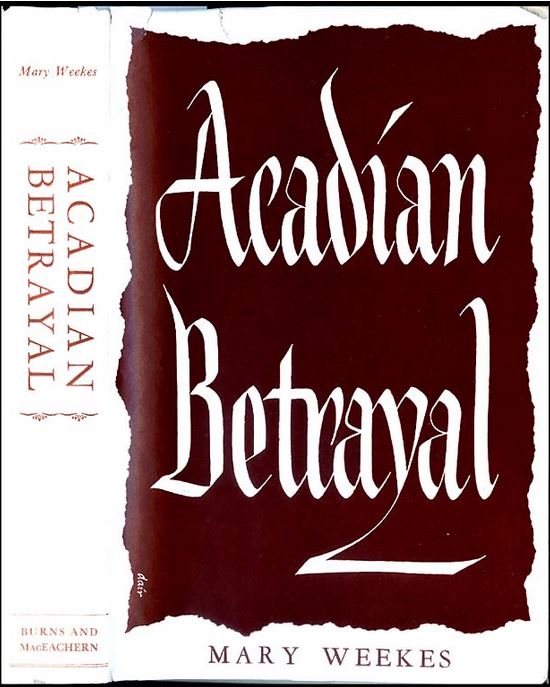
One again, I am returning to the story of The Pembroke.    In an earlier post (October 2010), I wrote  about the ancestors of Edith Mylott née Glode who in 1755 were exiled from Annapolis Royal aboard The Pembroke.  At that time, I didn't include the fact that an ancestor of Rivets, Prudent Robichaud, was also aboard that same vessel as well as others.  The story of The Pembroke is a true hardship story and probably one that historians will likely never know in detail.  The tragedy of The Pembroke was the basis of fiction by Mary L Weekes. 

A fictionalize story of The Pembroke can be read in Acadian Betrayal.  It use to be available on the internet.  If you cannot find a digital copy, it sometimes appears for sale on Ebay - but I suspect it wouldn't hold your interest for too long.  It is a typical melodrama.

The story of The Pembroke is a subplot in the tragedy of the Acadian people who were ousted, expelled, excised from the area around the Bay of Fundy from September through December 1755 by New England colonials under the authority of Governor Charles Lawrence and William Shirley, colonial governor of Massachusetts.  Over 7000 Acadian people were dispersed into small ships and sent to colonies along the North Atlantic seaboard and Haiti.  Some ships sank at sea, some were refused permission to dock and passengers remained without food and sanitary conditions in the ships while disease took over.  One ship, The Pembroke, was the exception. Its Acadian passengers overtook the crew and commandeered the ship across the Bay of Fundy to St John in present day New Brunswick.  On board that ship, were not only the Guilbault ancestors of Edith Glode and her sons, there also were the Robichaud, Melanson and Belliveau ancestors of Claire, Albert and Raymond Rivet of Cohoes, New York.  According to the article written by Paul Delaney on Acadian Ancestral Home, the probable leader of the Acadians on The Pembroke was Charles Belliveau. He is also the great great great great great grandfather of Claire, Al and Ray Rivet!!!


After bringing The Pembroke into the mouth of the St John's River, the Acadians were discovered by the English provoking an engagement, firing of arms, taking of English prisoners and ultimately burning The Pembroke so it could not be used against them.  Subsequently, the Acadians made their way to present day Fredericton, New Brunswick, then a French settlement called Saint Anne des Pays Bas where they wintered enduring malnutrition and exposure to the harsh environment.  The Rivet ancestor, Prudent Robichaud, quite elderly, died sometime during this struggle and somewhere along the Saint John River.  It is believed the Acadians including Charles Belliveau,  Charles Melanson, and their families made their way north via canoe on the St John's River through Grand Falls (Grand Sault) to present day Edmunston regions and then onto the Madawaska River to Lac Temiscouata (present day Quebec). The route continued from Lac Temiscouata overland and via waterways to Trois Pistoles on the south shore of the Saint Lawrence River concluding in Ville Quebec.  


Unfortunately, Charles Belliveau and Charles Melanson, like many of the Guilbault family, are believed to have succumbed to smallpox in 1758 and 1757, respectively, after completing their harrowing escape.

Below, the St John River near Fredericton, New Brunswick, Canada


Below is a recap of the stories written about Acadians in this blog so far.  This list includes some early posts that may not have been well researched but I am reviewing them for accuracy and hope they will "make the cut"!

Saturday, August 23, 2014

Remembering Acadian Ancestors in Rivet, Mylott and Wills-Beauvais Families

If you are a Rivet, Mylott, Beauvais, Bissonnette, St Hilaire, or Wills identified on the pages of FrancoAmerican Gravy,  you do not have an Acadian name but you do have Acadian ancestors!! All these families have Acadian great grandmothers who were exiled to Quebec at the the time of the Acadian Deportation.  These grandmothers and great grandmothers married into Quebec families and gradually assimilated Quebec customs. Then during the great industrialization of New York and New England, our families came south, assimilating again into the American mainstream. Most in our families lost our ability to use French.

I took a three week journey to remember these Acadian Ancestors and grasp their tragedy, their sorrow and perhaps some of their happiness too.

August 23, 2014 and I have just returned from  a three week journey through Quebec, Maine, New Brunswick and upstate New York to attend the Acadian World Congress in a part of the world I am not familiar. Here is the map and you can try to identify exactly where this land fits into North America.  Although, this area is not the original Acadia, many descendants now live in this area where the Acadian culture, cuisine, pride and French language remain strong and vibrant.


There's beautiful landscapes in the St John's River Valley, Passamaquoddy Bay, the Saguenay River Gorge, and the great St Lawrence.  The days were never terribly hot and the evenings were cool with striking sunsets.  People were always friendly.  Sometimes we struggled through the French and English barrier with smiles and laughs. Of course there's lot of wildlife - loons, eagles, moose, with whale and beaver lodge sightings. The blueberries were in season: blueberries and salmon, blueberries and crepes, lots of fresh blueberries, throughout the trip.  My trip was planned to remember Acadian ancestors and even though I have never identified myself as an Acadian and am totally assimilated into American culture, it was important and poignant. 

During the trip I kept a copy of John Mack Faragher's A Great and Noble Scheme (2005:W.W. Norton & Company) which was an easy introduction to the story of the Acadian people and the consequences of living  in a place and time among three warring states - the Micmac First Peoples, France and England.


When "Le Grand Derangement"  began in September 1755 and ended in December 1755, over 7000 Acadian people were dispersed into ships, scattered throughout the British colonies on the eastern seaboard and some French colonies such as Saint Dominigue (present day Haiti).  Exiled from their homeland, many never returned to Acadia. Thousands of other Acadians fled to surrounding territories in what in now northern Maine, Prince Edward Island and New Brunswick.

I highly recommend all members of our family become aware of their Acadian ancestors and their story. Contact me at FrancoAmericanGray@gmail.com.


Below is a recap of the stories written about Acadians in this blog so far.  This list includes some early posts that may not have been well researched but I am reviewing them for accuracy and hope they will "make the cut"!

Monday, January 20, 2014

Three 8th Grade Graduations at St. Marie's, Cohoes, NY 1932, 1933 and 1936: Rivet, St Hilaire, Bissonnette and many more

A sincere "thank you" to Mr. Joe Carlin from Cohoes for these wonderful photos! 

1932 Marie Claire Rivet, below, seated on far right:


 1933 Joseph Albert Rivet, below, seated second from far right.  With Arthur Louis St Hilaire standing directly behind him:


1936 Raymond Dedace Rivet, below, standing in the third row back from the priests. He is the third student from the left.  Also in this photo is Therese Bissonnette in the front row, third from right.


Tuesday, January 1, 2013

Lacasse Family in Northside, Waterford circa 1900


The Lacasse family are ancestors of the Rivet family of Cohoes

Dedace Lacasse, one of the younger sons in the family of Ephrème Cassé and Luce Desautels-Lapointe, was probably made a wanderer by virtue of his birth order. Without a plot of his own land to farm, he was consigned to be a day worker on the farms of others. 

Portrait of woman believed to be Lucie Lapointe-Desautels, the mother of Dedace Lacasse.


Dedace and his wife Marie Louise Mireault were both born in St Jacques de L'Achigan, Quebec - Dedace in 1844 , Marie Louise in 1849. The couple married in 1867 in the church of St Alphonse de Rodriques, Quebec. In the 1881 census of Canada, the family is in Terrebonne, Quebec. In the 1891 census, they are located in Joliette, Montcalm, Quebec.  Sometime around 1898, Dedace brought his family from Quebec to New York.  They came to Northside in Waterford in 1898 to work in or around the factory mills of Cohoes and Waterford.  In the United States Census of 1900, six family members are listed: Dedace, Marie Louise his wife, Marie Ann and Marie Louise his two daughters and Edmond (Edward) and Camille, his two sons.  Marie Ann will not marry remaining at home to care for her parents, especially her widowed mother.  Marie Lousie will eventually became the second wife of Paul Emile Rivet. Edmond, naturalized a US citizen in 1912 will marry in Cohoes but after he is widowed in 1926, he will return to Québec with his children. He marries again in Rimouski, Québec.  Camille Lacasse seems to have moved to New York City but returns to Cohoes to marry.  He and his bride return to New York and raise their family in Queens.  Another son, Joseph Lacasse, not listed in the 1900 census with his parents,  marries and remains in Cohoes to raise his family.


 The Lacasse Family living at 20 Cemetery Road, Northside Waterford

Note the error - Cammile is listed as a daughter instead of son 


On May 1, 1910 Marie Edna Ann Lacasse, daughter of Joseph Lacasse and Emma Marie Fortin, granddaughter of Dedace and Marie Louise Mireault was baptized in the "French" church,  St Ann's Roman Catholic Church in Northside, Waterford where the family members were communicants.  Dedace was listed as the parrain or godfather. Below are two photographs of St Anne's Church in Northside after it was converted to Waterford Wesleyan Church.


Readers unfamiliar with Northside, Waterford and Cohoes may inquire why Northside is called "Northside" when it is actually on the south side of the town of Waterford of which it is a part.  It is my understanding that the founding fathers of Cohoes always considered Northside a part of the Cohoes community even though Northside was officially in a different town and even a different county.  Cohoes is in Albany County and Northside-Waterford in Saratoga County.  Only the waters of the Mohawk River divide the communities of Cohoes and Waterford but an early bridge connected the communities.

So the family of Dedace Lacasse and Marie Louise Mireault expanded and their descendants quickly spread across North America and back to Quebec

Here is a sign of Northside's French Canadian Heritage!
A home in Northside, New York displays its Roots - a flag of Quebec and a US flag!

Part 2 to follow.....

Thursday, November 22, 2012

Marie Louise Lacasse


This is the funeral card of Marie Louise LaCasse Rivet, biological mother of Marie Claire Rivet, Joseph Albert Rivet and Raymond Dedace Rivet.  Marie Louise was born in Saint-Côme, Joliette, Québec and dies in Cohoes, NY, USA.  Thank you to the widow of  Uncle Ray Rivet for sharing this card.

Saturday, March 31, 2012

More Mapping the Route: Québec to Cohoes, Waterford

I am fascinated when I think about how French speaking Quebecers made their way to the Cohoes area in the 19th century. Essentially all the ancestors on this blog: Mylott, Allard, Glode, Rivet, Beauvais, Bissonnette, Guertin (Yetto), Hamel, Lord, LaCasse, Kagle, Guay and St. Hilaire made their way from somewhere in Quebec to the Cohoes - Waterford - Troy area. The powerful waters of the Mohawk River falling over the Cohoes Cataract and the thoroughfare the Hudson River provided made Cohoes and Troy an industrial hub where textiles, iron axes, and brick masonry were manufactured and iron foundries flourished.  Cohoes offered employment - steady employment to French Quebecers whose large families exhausted land resources.  During the 19th century these families poured into mill towns of New England and upstate New York.

Many of the ancestors families of this blog came in similar fashion and similar times and others came in somewhat unique circumstances.  Let's take a look at some of the families, the ancestors and the routes they may have traveled to upstate New York.

TRAIN: Solyme Beauvais and Adele Guay left St Cesaire, Rouville,Quebec and arrived in Cohoes between 1862-1870.

TRAIN: Moise Bissonnette and Julia Kagle came from St Jean sur Richelieu, Quebec and arrived in Cohoes between 1844-1849.

TRAIN: Maxim Rivet and Marie Lord left St Jacques L'Achigan, Quebec and arrived in Cohoes about 1895.

TRAIN: Dedace LaCasse and Marie Louise Amireault came from Joliette, Quebec and arrived in Waterford  about 1898.

TRAIN: Jean Baptiste Guertin, later John B Yetto, baptized in St Hyacinth, Quebec in 1828 was living in Troy by 1860.

TRAIN: Louis St. Hilaire and Elisa Paré from St Patrice de Sherrington/Napierville, Quebec went to Cohoes about 1892.

TRAIN: The parents of Malvina Hamel, the stepmother who raised Claire, Al and Ray Rivet, were Joseph Hamel and Charlotte Josephine Lambert who came from St Cesaire, Rouville, Quebec to Cohoes between 1867-1868.


and the English speaking ancestor....
TRAIN: After emigrating form Cornwall, John Albert Berryman Wills and his wife, Anne Reed, made their way from the area of the Huntington Copper Mine in Bolton, near Lake Memphremagog, Quebec to Port Henry on Lake Champlain between 1868-1870.  It is likely the first part our their journey was on the Canada Pacific Railroad from Newport, Vermont to St Albans, then continuing on the Rutland & Burlington to some port on the eastern shore of Lake Champlain, Vergennes, where they ferried to Westport and Port Henry in Essex County.


Depending on the time period, the trip on trains could be grueling or very grueling!  Quebec families who flooded New Hampshire, Massachusetts, Connecticut and Maine, often traveled the Grand Trunk Railway.  Those who came to Cohoes and upstate New York in the 1850s and 1860s need to negotiate a different route, one that was indirect and perhaps more arduous due to possible transfers in Burlington Vermont, again in Rutland Vermont, Whitehall NY, and Schenectady or Saratoga NY depending on the time period.

Online maps are available that can clarify passenger train routes which disappeared long ago or were taken over by D&H.  Below are just a few from 1849  demonstrating the lines between Rutland, Whitehall and Saratoga.  From Rutland it was possible to make a connection to the Saratoga & Washington Line running to Whitehall, Saratoga Springs, Ballston Spa and eventually Cohoes OR the Troy-Rensselaer & Rutland Line that ran from Castleton, Vermont through Rupert, Cambridge, White Creek, Eagle Bridge, Hoosick to Lansingburg.

 1849 railroad map


Below is another map published in a book describing the proposed Lebanon Springs Railroad 1866


Describes railroad routes to Montreal


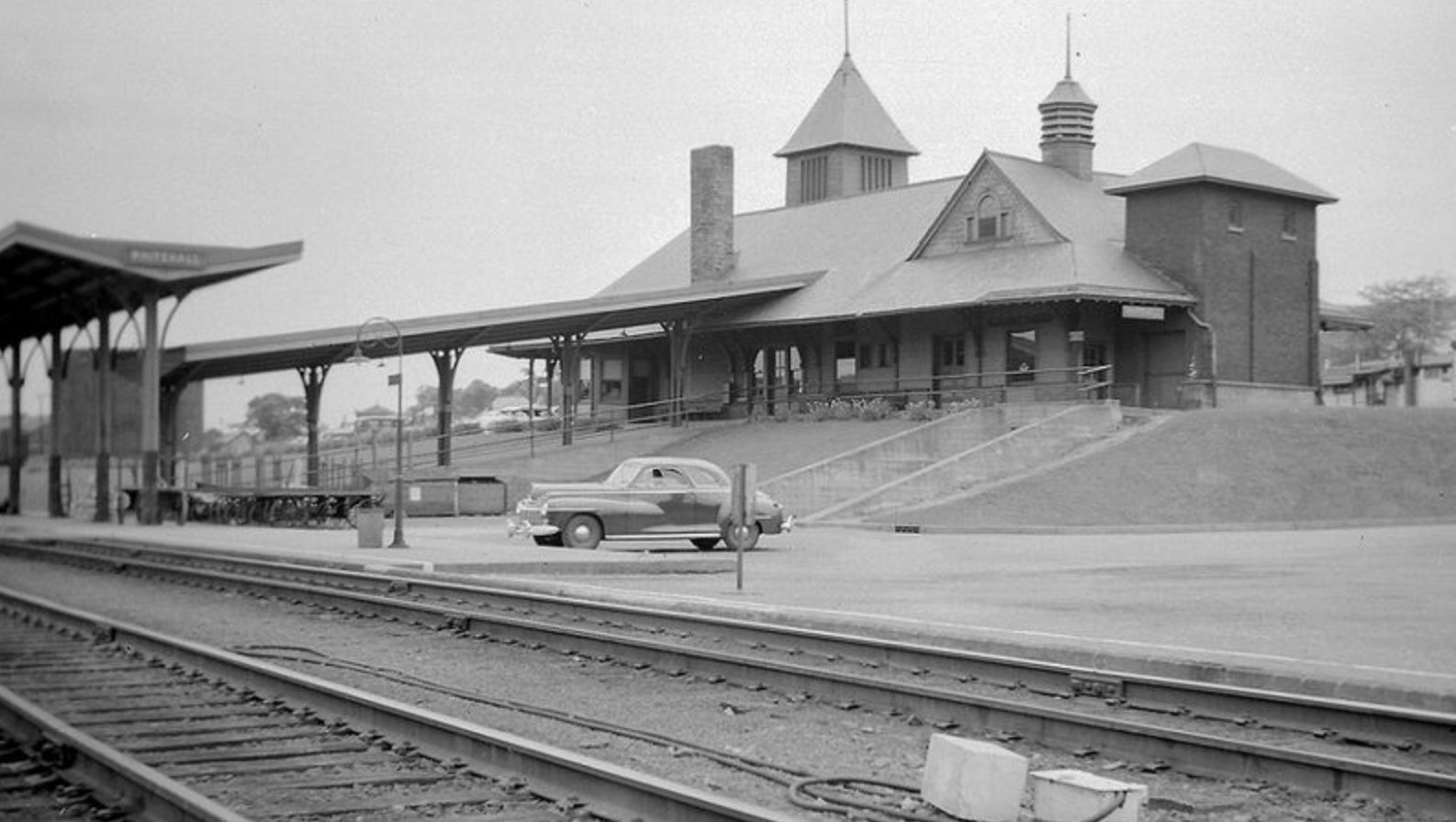
The Whitehall Train Station

The Whitehall Train station many years after our ancestors passed through

AND THEN THERE WERE THE CANALERS....


CANAL BOAT: Ancestors of Alex Glode and Angeline Allard, including Paquet, Allard, Duvernay, Beaudry, and Lalonde moved across the northern border to Champlain NY in the first half of the 19th century probably to farm the level lands there. Eventually, they became canalers along the Champlain Canal from Chazy to Whitehall and to Waterford, NY where they ultimately settled between 1890 and 1900.

CANAL BOAT: Robert Mylott, (Milot) baptized in 1832 in Vercheres, Quebec made his way from the Richelieu Valley, possibly St Jacques-le-Mineur Quebec to Whitehall NY in the 1840s. He was a very young man at the time. How he exactly made this trip we will never know although in an earlier post I made a guess. His grandson, Benjamin Mylott, a canaler eventually came to Waterford where he raised his family.