Showing posts with label Quebec. Show all posts

Thursday, September 4, 2014

If you visit Perce Rock.....

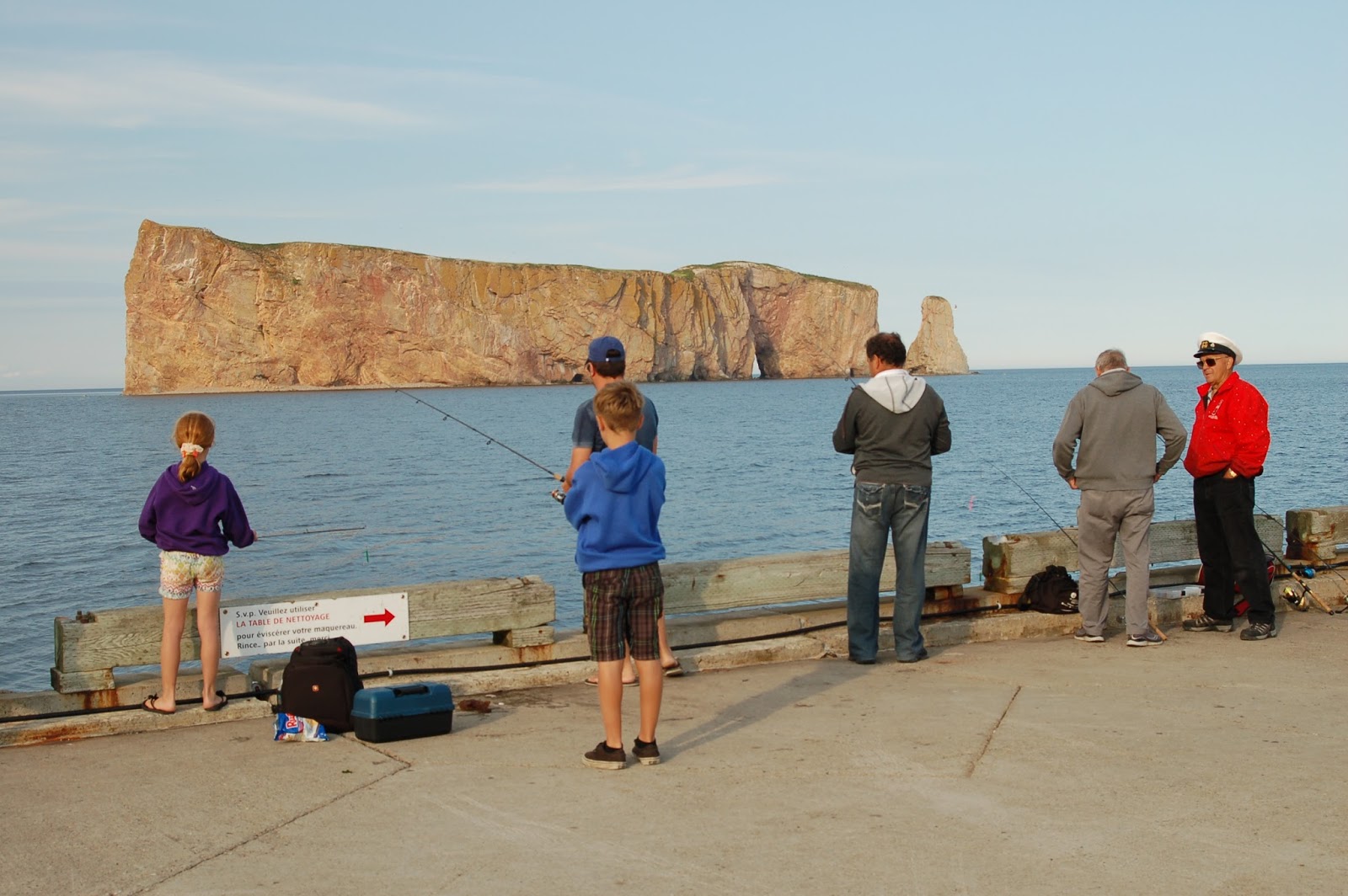
If you visit Perce Rock, remember to get up early, very early if you want to bond with the stone.  The best way to visit the rock is to wake up before the sun and start walking before other folks. Here's my photos when only a few people were up and about at Perce Rock.


late morning along the hiking trail behind the Catholic Church


back to the base of the trail


and then in the afternoon with the children fishing on the docks, the voices of families walking the board walk, the kayakers, the tour boats, bright sunshine...


and in the evening, sharing the view, sharing the shore with dogs


and finally at twilight


Sunday, August 3, 2014

Dejeuner

Sunday in Saint Roch des Aulnaies, at Au Cafe du Bon Dieu, along the Saint Lawrence, south shore.  The old presbytery is now a wonderful stop after visiting the church on a Sunday morning. After the services, the sexton was warm and welcoming.  He wanted to tell me the history of the church but my very limited French didn't make it an easy task.  One is able to walk close to the river where the morning fog was lifting.


Outside God's cafe, the fog was lifting off the St Lawrence..........

Road Trip through Quebec, New Brunswick and Maine

Taking the long way to my destination...

Sunday, December 2, 2012

Visit to Québec City circa 1949


Before the Eisenhower interstates were built, motor trips to Québec City from Cohoes took more than one day.  This trip recorded in the filmstrip below, sometime in 1949 or 1950, went through New Hampshire instead of along Route 9 and the Champlain Valley in New York to Montreal.  (there's more footage of that segment of the journey still to be posted).  Probably the family was more intent on making a religious pilgrimage to St Anne de Beaupré than visiting Montreal so the northeastern route through the White Mountains to St Anne was reasonable and more like a week long vacation.


Al Rivet probably held the Kodak camera, while his father Emile and stepmother Malvina Hamel enjoyed the cruise on the St Lawrence and the silhouette of the Hotel Frontenac, the tall dark building in the filmstrip.  The scene quickly changes form Quebec City to the Shrine of St Anne de Beaupré, the Scala Santa, the convent grounds and the busy parking lot!


Years later as a child, I would accompany these adults on this pilgrimage many times and follow the tradition of ascending the stairs of Santa Scala on my knees while praying the rosary - in English.


Saturday, March 31, 2012

More Mapping the Route: Québec to Cohoes, Waterford

I am fascinated when I think about how French speaking Quebecers made their way to the Cohoes area in the 19th century. Essentially all the ancestors on this blog: Mylott, Allard, Glode, Rivet, Beauvais, Bissonnette, Guertin (Yetto), Hamel, Lord, LaCasse, Kagle, Guay and St. Hilaire made their way from somewhere in Quebec to the Cohoes - Waterford - Troy area. The powerful waters of the Mohawk River falling over the Cohoes Cataract and the thoroughfare the Hudson River provided made Cohoes and Troy an industrial hub where textiles, iron axes, and brick masonry were manufactured and iron foundries flourished.  Cohoes offered employment - steady employment to French Quebecers whose large families exhausted land resources.  During the 19th century these families poured into mill towns of New England and upstate New York.

Many of the ancestors families of this blog came in similar fashion and similar times and others came in somewhat unique circumstances.  Let's take a look at some of the families, the ancestors and the routes they may have traveled to upstate New York.

TRAIN: Solyme Beauvais and Adele Guay left St Cesaire, Rouville,Quebec and arrived in Cohoes between 1862-1870.

TRAIN: Moise Bissonnette and Julia Kagle came from St Jean sur Richelieu, Quebec and arrived in Cohoes between 1844-1849.

TRAIN: Maxim Rivet and Marie Lord left St Jacques L'Achigan, Quebec and arrived in Cohoes about 1895.

TRAIN: Dedace LaCasse and Marie Louise Amireault came from Joliette, Quebec and arrived in Waterford  about 1898.

TRAIN: Jean Baptiste Guertin, later John B Yetto, baptized in St Hyacinth, Quebec in 1828 was living in Troy by 1860.

TRAIN: Louis St. Hilaire and Elisa Paré from St Patrice de Sherrington/Napierville, Quebec went to Cohoes about 1892.

TRAIN: The parents of Malvina Hamel, the stepmother who raised Claire, Al and Ray Rivet, were Joseph Hamel and Charlotte Josephine Lambert who came from St Cesaire, Rouville, Quebec to Cohoes between 1867-1868.


and the English speaking ancestor....
TRAIN: After emigrating form Cornwall, John Albert Berryman Wills and his wife, Anne Reed, made their way from the area of the Huntington Copper Mine in Bolton, near Lake Memphremagog, Quebec to Port Henry on Lake Champlain between 1868-1870.  It is likely the first part our their journey was on the Canada Pacific Railroad from Newport, Vermont to St Albans, then continuing on the Rutland & Burlington to some port on the eastern shore of Lake Champlain, Vergennes, where they ferried to Westport and Port Henry in Essex County.


Depending on the time period, the trip on trains could be grueling or very grueling!  Quebec families who flooded New Hampshire, Massachusetts, Connecticut and Maine, often traveled the Grand Trunk Railway.  Those who came to Cohoes and upstate New York in the 1850s and 1860s need to negotiate a different route, one that was indirect and perhaps more arduous due to possible transfers in Burlington Vermont, again in Rutland Vermont, Whitehall NY, and Schenectady or Saratoga NY depending on the time period.

Online maps are available that can clarify passenger train routes which disappeared long ago or were taken over by D&H.  Below are just a few from 1849  demonstrating the lines between Rutland, Whitehall and Saratoga.  From Rutland it was possible to make a connection to the Saratoga & Washington Line running to Whitehall, Saratoga Springs, Ballston Spa and eventually Cohoes OR the Troy-Rensselaer & Rutland Line that ran from Castleton, Vermont through Rupert, Cambridge, White Creek, Eagle Bridge, Hoosick to Lansingburg.

 1849 railroad map


Below is another map published in a book describing the proposed Lebanon Springs Railroad 1866


Describes railroad routes to Montreal


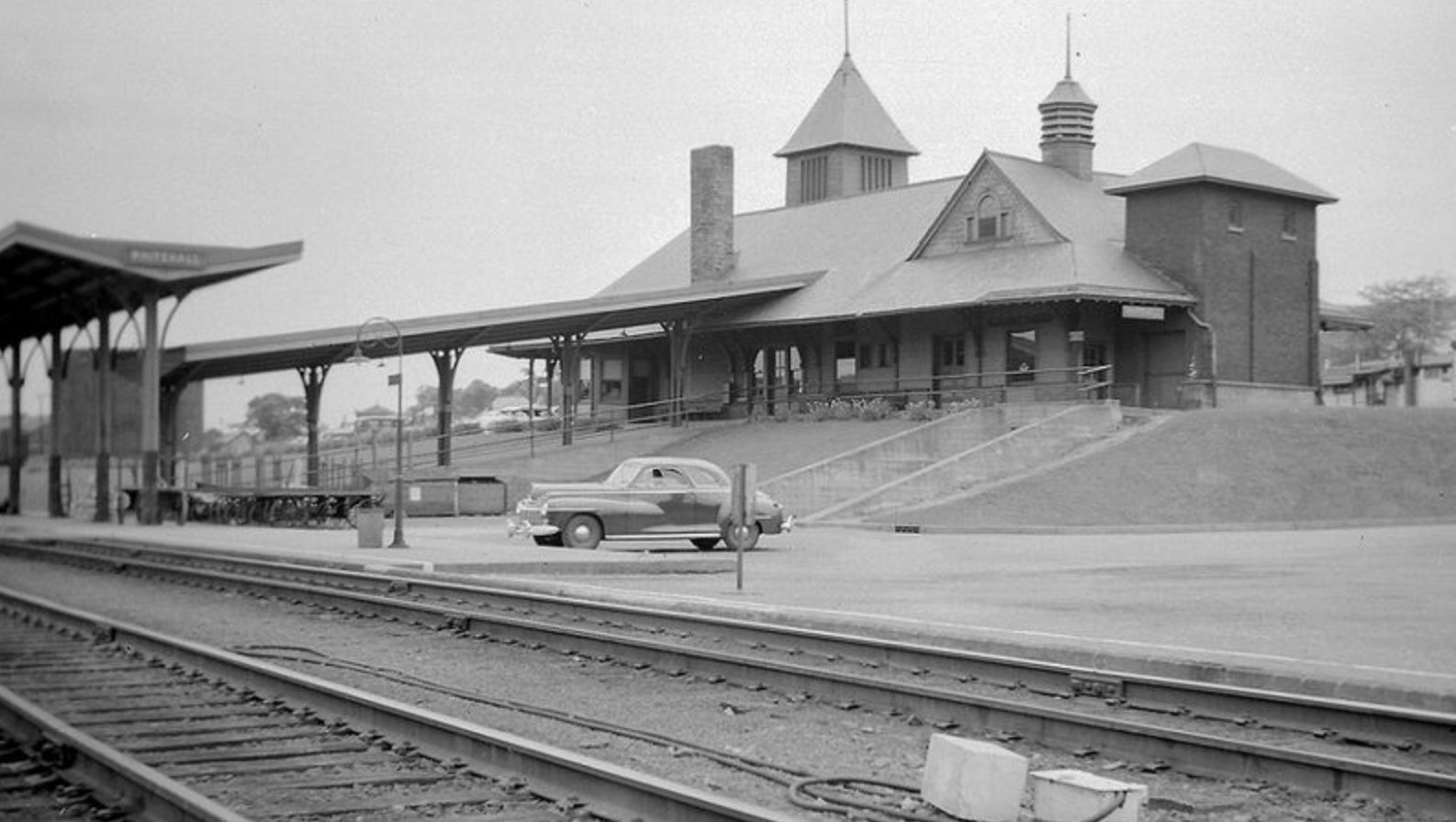
The Whitehall Train Station

The Whitehall Train station many years after our ancestors passed through

AND THEN THERE WERE THE CANALERS....


CANAL BOAT: Ancestors of Alex Glode and Angeline Allard, including Paquet, Allard, Duvernay, Beaudry, and Lalonde moved across the northern border to Champlain NY in the first half of the 19th century probably to farm the level lands there. Eventually, they became canalers along the Champlain Canal from Chazy to Whitehall and to Waterford, NY where they ultimately settled between 1890 and 1900.

CANAL BOAT: Robert Mylott, (Milot) baptized in 1832 in Vercheres, Quebec made his way from the Richelieu Valley, possibly St Jacques-le-Mineur Quebec to Whitehall NY in the 1840s. He was a very young man at the time. How he exactly made this trip we will never know although in an earlier post I made a guess. His grandson, Benjamin Mylott, a canaler eventually came to Waterford where he raised his family.


Tuesday, July 5, 2011

Day 7: Last Day on the French Canada Tandem Tour!

Day 7 Cowansville to St. Bernard de Lacolle
Rides of 45 or 51 miles

This is an amazing day of riding on mostly flat country roads, returning to St Bernard. Bike through Mystic, to see the imposing twelve sided barn built by the Walbridge family. Enjoy this barn, now a museum and national heritage site.  Ride along Lake Champlain, into the US, with its wonderful lakeside views and restaurants. We pass old stone buildings and wonderful countryside in Vermont and New York. Then we return over the border to Canada and St Bernard.


More roosters! Québec loves roosters! This one protect the garden - 
A scare rooster!

Eight sided barn in Mystic

Another covered bridge over the Brochette River

Brochette River translates to Pike River


At the covered bridge we met and spoke with this young man riding his bike.  He was a farmer who now allows his son to direct the family business. He told us he came to this area of Stanbridge sixty years ago from Belgium.  He was a teenage soldier in WWII and remembered well the Battle of the Bulge.  He farmed the corners near the covered bridge and his wife cultivated a beautiful garden across the way.  Now days he suffers from macular degeneration -  but gets around on his bike.  He pointed out the locations of the sawmill, now gone and an area in the Brochette River where there was a small dam to power the mill.  He told us Charlotte Trottier Desrivières, née Guillimin, the wife of James McGill, founder of McGill University in Montréal, was a native from these parts.   Set back in the woods off the road was a "mansion" (it was- I could see it from the road) that had something to do with Charlotte and McGill....

Searching online I found this site in French from the Notre Dame de Stanbridge site.  The Google translation is..not very good but here it is...


Malmaison in Notre-Dame de Stanbridge

SendPrintPDF

MALMAISON OF OUR LADY OF STANBRIDGE

Family Desrivières
In 1801, King George III conceded to Hugh Finlay, 31.000 acres in the western part of the Township of Stanbridge.
Hugh Finlay died the same year and it is James McGill, who became owner of the concession.
James McGill, born in Glasgow, Scotland (1744) had married Marie-Charlotte Guillemin, widow of Joseph Amable Trottier said Desrivières, who had left two son, François and François-Amable Hyppolithe.
James McGill died December 19, 1813 and bequeathed to the "Royal Institution for the Advancement of Learning," $ 40,000, and its ownership of Burnside for the construction of a College or University. (McGill University in Montreal was built in 1821).
François-Amable Stanbridge inherits the territory of the death of his adoptive father, his brother Francis Hyppolithe died following a duel in 1799.
In 1830, François-Amable, in turn, dies and bequeaths to his two son François-Henri Guillaume and all his possessions and conceded the territory of Stanbridge formerly Hugh Finlay.
1842-1877: "Malmaison"
Both the son of François-Amable Desrivières then settled around 1841, this territory loyalist with the aim to grow their business, which consists in treating wood, grain, flour, and later in transport their goods by train. (1860)
At the place called "Malmaison" on the river called "Pike River" a village is formed and a community develops. A dam is built across the river to enable a sawmill and a gristmill on both sides of the River. A bridge is needed to enable residents and workers to go to one or the other mills. Desrivières then build a chapel, a station (the Central Vermont Company), a general store, post office, school, and that a community is formed, so that by 1848, the place called "Malmaison" the name of the family residence Desrivières, which now has more than 200 people, is constituted as a municipality is that of Our Lady of the Angels of Stanbridge, as the first mayor with Mr. Henri Desrivières, the the most influential man of the time. The latter was also the prefect of the Corporation of the County of Missisquoi, a position he held in 1856 and 1857.
This town, one of the first to be established in this part of the Province of Lower Canada, which included lots numbers 1 to 146 of the eighth concession of 31,000 acres Sabrevois and the Township of Stanbridge, administer this great country for over forty years until March 21, 1889 while the Government of Quebec  formed from the same area three new municipalities: Stanbridge-Station, St-Ignace de Stanbridge and Notre-Dame de Stanbridge.
Stanbridge St Charles or "couture": 1850 - 1889
A two and a half miles north of Malmaison, there was a craft center known as St Charles Stanbridge which is commonly called "couture", the name of the largest owner of the place.
Joseph Couture, (son of Julien) was an ambitious and enterprising man, who, seeing the prosperity of other villages and towns Stanbridge, decided to establish several companies around the power of water given to him by the Pike River.
Enjoying a water level higher than at Malmaison, the small craft center of "couture" has been growing faster than the first and has been gaining importance in industry, commerce, population and this at the expense of Malmaison.
Thus in 1880, there are between each other: a flour mill, a sawmill, a carding mill and a large plant tissues, all properties of Joseph Couture, and to complete the "picture" a butter factory, a tannery, a blacksmith shop, several general store, a post office, a school and a beautiful new church opened December 25, 1879 at midnight mass.
Proud of a growing population, St Charles de Stanbridge, March 21, 1889 became the Municipality of Notre-Dame de Stanbridge.
On June 27, 1913, a Decree of Council of the Government of Quebec annexed to the Municipality of Notre-Dame de Stanbridge lots numbers 1 to 105 of the Lordship of Sabrevois belonging to the Municipality of Notre-Dame des Anges, which was dissolved the same days.
Notre-Dame de Stanbridge was the first town in several areas: in fact, this is the first municipality was incorporated in the Province of Lower Canada, it is here that the first Catholic church was built in 1843 and is the first village of the township of Stanbridge to have had a predominantly French-speaking population in the nineteenth century, a territory reserved only for English-speaking Loyalists.
By the way of our day or was located Malmaison ie Desrivières in the row, near the covered bridge, it is difficult to imagine that this site was once a hub of activity for the family as significant as Desrivières for the 200 people who lived there and it drew the resources necessary for their well being.
As against the village of Notre-Dame de Stanbridge, some activity still prevails. While progress has eliminated the majority of companies of the nineteenth century. The place will remain peaceful and "pastoral" as the circular tourist. The river, which is for giving so much power hydraulic continues to delight us and make our village a better place to live.
My sources: Album of the centenary of Notre-Dame de Stanbridge
Missisquoi, a Store of Memories, Vol. XII
********

Then I found, on the same site, photos of the mill, the general store, and the busy community that once thrived near the covered bridge!  Everything the old veteran was talking about to us was about how, at this very corner we were on, there was once a thriving commercial  community. Time passes; it all changes.  The mill, the store, the commerce have all disappeared... but he remembers so well and we, passing by for a brief moment on our tandem, can only gasp for the meaning and the memory.


Good day Québec!
Until the next time.