Showing posts with label Lancaster R5695EM-C. Show all posts

Saturday, November 4, 2023

Remembering the crew of R5695-EMC and ALFRED JOSEPH PARKYN


BORN NOVEMBER 6, 1915

PALISADES, NEW JERSEY, USA 

27 YEARS OLD

Alfred J. Parkyn was the beloved son of an immigrant carpenter and his Parisian wife. Coming of age during the Great Depression, Alfred enjoyed many of the American Dream’s promises. He competed in high school football and track; he counted swimming, skiing, and horseback riding among his activities as well. Proud parents photographed the handsome, well-dressed young man astride a beautiful English-saddled mare. In the photograph, he smiles confidently. His riding boots shine.


Alfred landed a job with the United States Lines, crewing on the SS Leviathan between his junior and senior years of high school. Working in the engine rooms of SS Leviathan and later the SS President Roosevelt, Alfred saw England, France, and Germany during peacetime. He would later see many of these countries from the air, at night, under fire.

If Alfred and the first American Parkyns thought they’d escaped the harsher side of life when they put London’s Mile End behind them, they were wrong. Alfred saw the impact on the family of his uncle’s Edward’s death in France at the end of the First World War. Memories of Edward must surely have faded in young Alfred’s memory by the time Edward became the namesake of his town’s American Legion post. Tragedy didn’t end with the end of war. Alfred lost his 11-year-old brother during Alfred’s senior year in high school. Two years later, Alfred’s 50-year-old father passed away. The successive losses left Alfred’s mourning mother and sisters reeling but undoubtedly grateful for his stabilizing presence in the family. By 1940, Alfred’s life was on a course that kept him close to home. At 26 years of age, Alfred had a steady but menial job in the Bronx. His elder sister had married, leaving Alfred at home with his mother and 13-year-old sister Renee, who adored the big brother she knew as Allie. Over the course of 30 years, the Parkyn family’s exuberance and success had, through family tragedy and economic disaster, given way to a grittier determination to persevere together.

Alfred harbored dreams of becoming a pilot, but he was both too old and lacked the bachelor’s degree required for military pilot programs. Opportunities in civil aviation were scarce, and flight training wasn’t cheap. With his spare income, Alfred had managed to accumulate a meager eight hours of flight time and was making payments on a ground school course he’d taken.

At some time during the summer of 1940, Alfred must have come across one of the recruiting advertisements posted at municipal airports by the Clayton Knight Committee. Replete with images of Spitfire fighter planes, the flyers sought men for the Royal Canadian Air Force, and steered applicants to Knight’s shadow organization at the Waldorf Astoria Hotel. The Waldorf was on Alfred’s route home from work, but Alfred’s workday clothes would not have been in keeping with the hotel’s splendor; he must have made a trip from home, in his best clothes, when he applied.

And he did apply. His move must have concerned family elders, who would have numbered themselves among America’s isolationist population after Uncle Edward’s death. Without a steady income or husband, his mother must have found Alfred’s decision to be alarming.

Winning his wings in November 1940, Alfred flew home for a brief visit. Once in England, he wasted no time in connecting with family in Surrey, which became his favorite destination during leave periods. He wrote dutifully to his mother and sister, sending photos of “his” room above a Surrey shop, and the Earl Beatty Pub, where he enjoyed a pint now and then.

Alfred must have seemed brash and outspoken to his British squadron mates, as many Americans did. He was fond of them, describing them in a 1942 interview as “hard to get next to, sometimes,” but noted “they have horse sense. These guys know their racket.” Little memory exists of Alfred’s relationships with his fellow aviators – of the 400-plus men he could have met while flying with 207 Squadron, half were dead within a year of his final mission. Bomber Command’s low attrition – 3 percent – equated to certain death for aircrew within 34 missions.

Mere months after arriving at his bomber squadron, Alfred failed to return from a mission. His death was the fourth tragedy to strike the Parkyn’s in 20 years. After the war’s end, those surviving family members worried about work and the future. They moved apart to the corners of the United States leaving Alfred’s fading story behind them.

Alfred’s sisters never got over their sense of loss. Years later, the family children would remember his sisters, Gladys and Renee, speaking of their beloved brother "Allie" still haunted by the vague nature of his fate – missing, presumed dead, with no known grave.


Monday, April 24, 2023

Remembering the crew of R5695-EMC and JACK SLATER

 BORN APRIL 1921

DIED NOVEMBER 22, 1942 ON A BOMBING MISSION TO GERMANY

HYDE, CHESHIRE, ENGLAND

21 YEARS OLD

Little information is known about Jack Slater. His parents were William Slater and Elizabeth Radcliffe. He had an older brother, Harry, and a sister, Joyce.

In a group service photo, Jack stands in the third row back and on the extreme right with his hands behind his back. He stands slightly apart from the other airmen. Jack Slater, an air gunner, perished young and without the opportunity to leave his mark on the world he helped save from Nazi terror. In his twenty-one years, Jack’s deeds and dedication to duty impacted the world in ways he would never have known.

Jack, like so many other young men and woman without descendants and large families, may be overlooked in the annals of time and the genealogical records in paper archives. It is fitting that now, eighty years after his sacrifice, and in the years to come, Jack be remembered by the family of man and citizens of free nations for his extreme sacrifice.


Monday, April 17, 2023

Remembering the crew of R5695EM-C and WILLIAM JOHN VANDERVOORT

 BORN APRIL 17, 1916

DIED NOVEMBER 22, 1942 ON A BOMBING MISSION TO GERMANY

VANCOUVER, BRITISH COLUMBIA, CANADA

26 YEARS OLD


William J. Vandervoort, was born on April 17, 1916, the youngest child of Emma and Ernest Vandervoort, in Vancouver, British Columbia. William and his siblings, Harold, Walter, and Margaret were raised at 2596 Cornwall Street, Vancouver where William attended nearby Kitsilano Secondary School from 1928 to 1934. He is memorialized in a plaque at the school. In 1935, after his secondary education, William was employed by Davidson & Company, where he was a floor trader on the Vancouver stock exchange. He played football with the Meralomas and the Knights of Columbus. On his application to the RCAF, he listed “Canadian Football, baseball, tennis, golf extensively – all others occasionally.” He also listed hunting, hiking, and skiing as his hobbies. In family photos, he appears handsome, athletic, and very fashionable.

William enlisted in the Royal Canadian Air Force on August 2,1940 and was promoted to Flight Sargent on July 1st, 1942. Later that month he was assigned to Squadron 207. He wrote home after the October 17th, 1942 Le Creusot Raid when, as bomb aimer, he was positioned in the nose of the aircraft. His father retold his son’s encounter to the local newspaper:

“Van” Vandervoort of Vancouver Breweries tells a good one about his son. “Van” was a pretty nifty pheasant shooter in his day but apparently his son has him beaten. The boy was in the “nose of a kite” (Lancaster) going over France and suddenly he was stunned by something hitting him on the chest. “I thought sure I was dead. It turned out to be a pheasant. We were doing more than 200 miles an hour at the time. It was splattered all over my compartment, the biggest piece being a leg. Boy, such a mess!”

Among his possessions listed were “skating boots with skates,” a New Testament, a diary, 2 packs of playing cards, 1 silk tie, 1 watch with broken glass, 2 pullovers and 30 socks.


Tuesday, April 11, 2023

Remembering the crew of R5695EM-C and EUGENE EDWARD CHOUINIERE

 BORN APRIL 11, 1923

DIED NOVEMBER 22, 1942 ON A BOMBING MISSION TO GERMANY

HALFMOON, SARATOGA COUNTY, NEW YORK and COHOES, ALBANY COUNTY, NEW YORK

19 YEARS OLD


Eugene E. Chouiniere was from a large Franco-American family in upstate New York. Eugene’s parents, Alfred Chouiniere and Rose Bonneau, married in Cohoes, New York in February 1895 and farmed in rural Waterford where Eugene was born on April 11th, 1923. He was the youngest of 13 children. When his father died, Eugene was 5 years old and 15 when his mother died. His older siblings, especially his oldest sister Rose, took responsibility for his welfare. In 1940, Eugene was living on Lansing Lane in Cohoes with Rose, her husband, and their two daughters, Elizabeth and Lea. Lea always remembered spending time with the companion of her teen years who was also her uncle. They hunted in the fields and fished in streams all summer long.

When Eugene attempted to join the US armed forces the recruiter told him to first finish high school and then reapply. Greatly disappointed, Eugene waited until a few days after his 18th birthday and “jumped on the train to Montreal” and enlisted in the Royal Canadian Air Force. The RCAF interviewer noted he was “rather young, immature and lacking in experience.” He was also “sincere, willing and determined to fly and fight” and “should improve with training.”

After his training in Canada and before he was sent to England, Eugene took leave to visit his siblings back in upstate New York. Handsome in his RCAF uniform, Eugene was showered with his family’s attention - many photographs were taken. This would be the last time the Chouiniere family saw their little brother. In England, after more training, Eugene became an air gunner flying missions in RAF Squadron 207 based at the Langar Airfield near Nottingham, England. After the July 31st, 1942, raid on Düsseldorf, Germany, Eugene was interviewed by several war correspondents. The story was published in The San Francisco Examiner on August 2nd with the headline “DÜSSELDORF RAID THRILLS U.S. FLYER”. Eugene was quoted: “It was one of the best shows I have ever seen. When we left there was one tremendous fire keeping high and visible from the Dutch coast.” Another correspondent described Eugene as “freckle-faced with steel- rimmed glasses and a mild manner.” He was really a small-town boy who took to the mission with dedication and purpose. Eugene completed 13 missions in 1942 while in the RAF Bomber Command.

Tuesday, March 21, 2023

Remembering the Crew of Lancaster R5695EM-C and JOHN JAMES GALLIMORE

BORN MARCH 21, 1916

DIED NOVEMBER 22, 1942 ON A BOMBING MISSION TO GERMANY

DENTON, MANCHESTER, LANCASHIRE, ENGLAND

26 YEARS OLD

John James Gallimore, “Jack,” was born on 21 March 1916 in Seymour Street, Denton, Manchester, Lancashire, England to John Henry Gallimore and Alice Walker. He was the oldest of 6 children. His only brother, Albert Edward (Ted), also served in WW2. He was always remembered by his four sisters, Elsie, Beatrice, Marian, and Enid. All the Gallimore children attended Denton Central school and the children were good scholars. They attended Christ Church in Denton where Jack joined the Boy Scouts. After Jack was lost, Beatrice Gallimore spent many hours passing memories of “Uncle Jack” to her children often recalling the special sense of humour he used with his sisters. Beatrice remembered an occasion during rationing when each person was only allowed 2 ounces of butter each week. Jack, beloved brother, keenly wanted a crumpet with butter filling the spongy holes. His loving family gave in with a wink and a smile. Everyone in the family gave up their share for Jack to fill the crumpet craters! When the war started Jack decided he wanted to join the RAF. He enrolled and was based in Lincolnshire where he met and married Dora Farmer in Wolverhampton, Staffordshire on Valentine’s Day 1942. Jack’s family remembered that when she learned she had lost Jack, Dora was grief stricken and heartbroken. When she finally remarried more than ten years later, she brought her fiancé to meet Jack’s parents to get their permission. Jack was the only crew member known to have married. The last time Jack was home on leave, Beatrice remembered she wanted to give him ‘half a crown,” her usual gift whenever Jack visited home and returned to the airbase. Beatrice had saved her money and was prepared to give it to Jack when he was ready to leave but one of her older sisters quickly asked her if she had half a crown. Beatrice told her she did, but it was for Jack. The sister convinced the younger Beatrice that she needed the money so Beatrice gave it over to her sister who promptly gave it to Jack. Poor Beatrice was upset, especially because it was the last time she ever saw her brother. 7 When Jack and the crew were reported missing, Jack’s family – just like all other families - spent endless hours writing to various government departments to learn what had happened to their son, their brother, and their husband with no resolution. Even after Jack’s mother died, the family carried on searching. Jack was christened and confirmed into the Church of England. He made a promise to his mother that wherever he was on Easter Sunday & Christmas Day, he would take communion honoring her wishes.

James Gallimore and his bride, Dora Farmer

Wednesday, February 15, 2023

Remembering the Crew of Lancaster R5695EM-C and JAMES MCGREGOR ALLAN

BORN FEBRUARY 16, 1918

DIED NOVEMBER 22, 1942 ON A BOMBING MISSION TO GERMANY

MIMICO, ONTARIO, CANADA

24 YEARS OLD

James McGregor Allan, a British citizen, was born in Aberdeen, Scotland and emigrated to Canada with his father and mother in 1922 when he was 4 years old. They settled in Mimico, a neighborhood in the southwest of Toronto, where James attended public schools. Two sisters were born in Ontario, Gertrude, and Gail. In 1934 after two years of high school, James was employed at Campbell’s Soups “working on filling machines”. He left for a better job as a warehouse worker at Roofers Supply Company from 1939-1940. His hobby was building model planes and his best sports were hockey and swimming although he occasionally boxed, played lacrosse and baseball. He was a reserve Royal Canadian Engineer.

His Royal Canadian Air Force interviewer described him as “Splendid type of chap but lacks education. He is willing to work hard, very keen and alert, good appearance, determined to make the grade and should develop under training into good gunner material.” He was also “confident, mature, and pleasant.” After completing Air Training, it was remarked James was “Neat and mannerly, seems quite levelheaded. Has worked hard on course.” He received his air gunner badge on December 6th, 1941. James overcame his lack of formal education and made his way to Squadron 207.

The loss of their only son was hard on the Allan family. James’ father died less than two years after his son.


Declaration of Passenger to Canada
James, 4 years old, accompanies his parents to Toronto.


 Other stories in this blog about Lancaster R5695EM-C:

Memorial Service - 80 Years Later

Promise to Lea


Friday, December 16, 2022

The Memorial Service marking the 80th Anniversary of the Loss of R5695EM-C at Langar Airfield, Nottingham

Standing on the airstrip at Langar Airfield on a bright afternoon was culmination of a twelve year quest that began when I met Lea.  Since that meeting and especially in the past 2 years,  Vandervoort, Parkyn, Chouiniere, Allan, Webb, Gallimore, Slater and Guichard family members, came together through snail mail letters, emails, a Facebook group, and blog posts to share stories and photos of the crew.

Then during the week of November 20th, we came together in person for the first time to remember the crew. Several American and English family members scheduled a 3 day tour with Classic Battlefield Tours to immerse ourselves in the history of RAF Bomber Command and Lancaster aircrafts.  We visited Runnymede Air Force Memorial, the International Bomber Command Centre and Memorial in Lincoln.  We stayed at The Petwood Hotel where RAF Dambusters located their operations center in WW2.

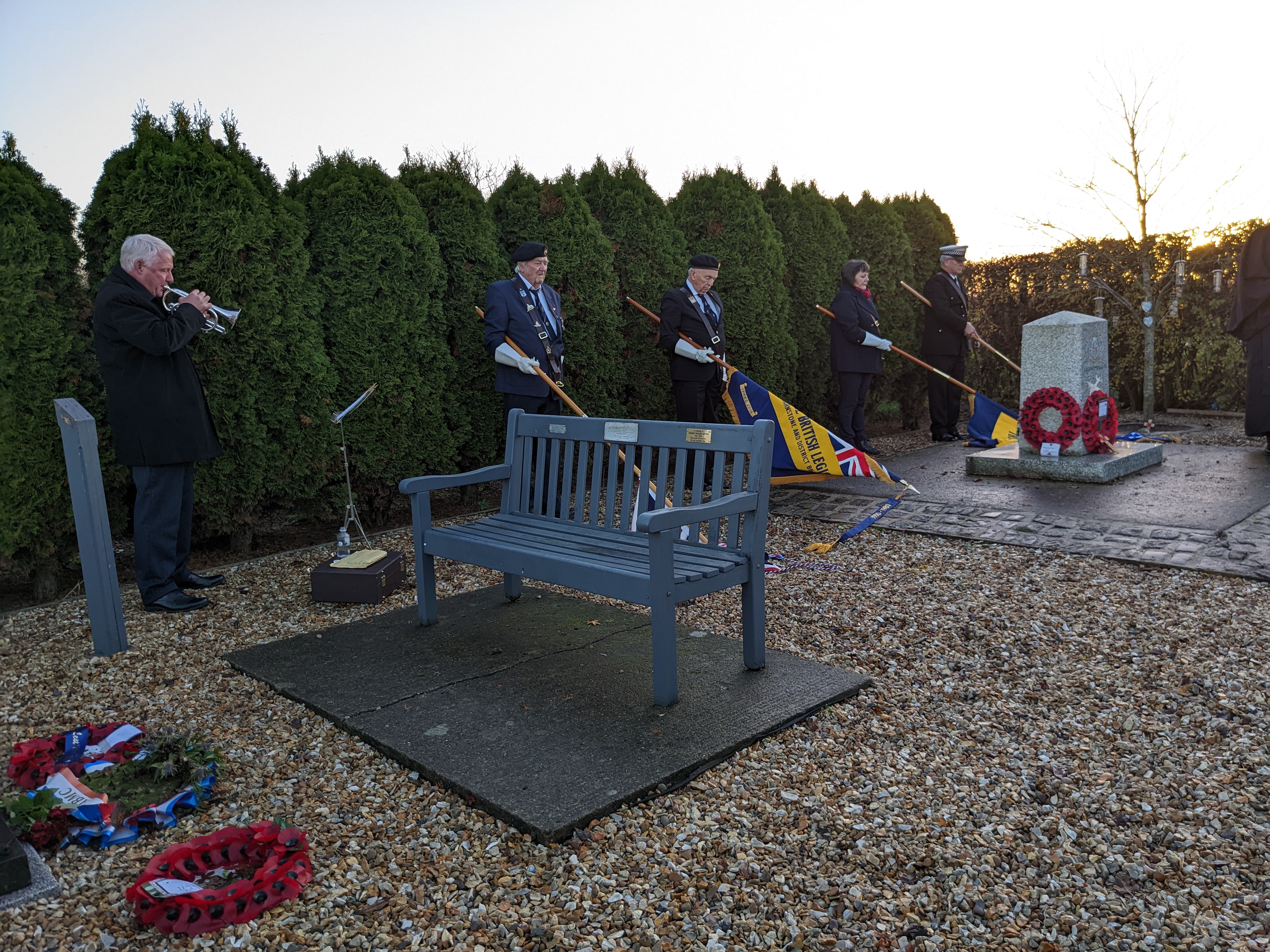
The location, the history, the aircraft and story sharing were all memorable and brought us the focus for the memorial on November 25th.  The service had many parts...

The indoor service in the control tower included a presentation of the Langar Airfield's history by Nigel Wood, a poem written and recited by Bill Webb that captured our thoughts and hearts, Psalm 23 reading, an address by Rev. Jonathan Stewart of 207 Squadron, and an  recitation of Oration by Pericles:

"But each one, man by man, has won imperishable praise, each has gained a glorious grave - not that sepulchre of each wherein they lie, but the living tomb of everlasting remembrance wherein their glory is enshrined, remembrance that will live on the lips, that will blossom in the deeds of their countryman the world over. For the whole world is the sepulchre of heroes; monuments may rise and tablets be set up to them in their own land, but on far -off shores there is an abiding memorial that no pen, no chisel has traced; it is graven not in stone or brass, but on the living hearts of humanity.  Take these men for your example.  Like them, remember that prosperity can only be for the free, that freedom is the sure possession of those alone who have the courage to defend it."  

Noted at the International Bomber Command Centre

Then we proceeded to walk to the Squadron 207 memorial along the rim of the airfield and where we  lovingly laid wreaths and poppy sticks to our crew.


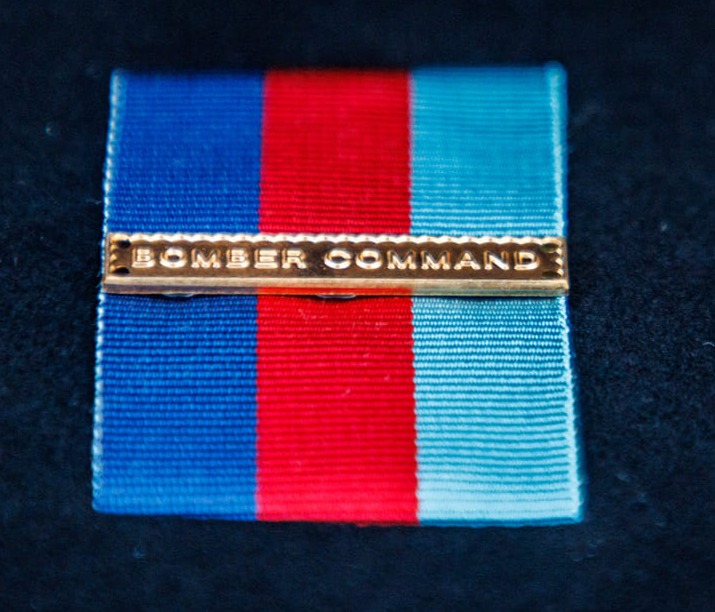
After returning to the main building, Rev. Stewart presented each of the families with the bomber clasp.


Five Avro Lancasters and crews took off from Langar Airfield 80 years ago.  Three returned in the evening, two did not.  'C' for Charlie and its crew was 'lost without a trace' but on this day, we found them - Al, Jack, Jim, John, Windsor, Eugene, James and William and held them in our hearts.

It was twilight by then. 

Ali Webb and Kare Khoo from Webb Street Studios generously filmed and edited the memorial service at Langar.  Their  video is on Vimeo here.

Thursday, November 17, 2022

80 years later, I am going to Langar Airfield

In July 2010 I met Lea Langlais for the very first time.  I wanted to record her story about growing up Franco-American in Cohoes, NY in the 1920s and 1930s.  Lea didn't want to talk about that on that day.  She wanted to tell me about her uncle, Eugene Edward Chouiniere who was a mere six months older than her.  She wanted me to find out what happen to Eugene and the other crew who disappeared without a trace. "Can you find out if there is any new information?" she asked me.  Since that day Lea's story about Eugene has haunted me.  Her family never learned what happened on November 25, 1942 when the aircraft, R5695EM-C, never returned to Langar Airfield in England.  

The last letter in Eugene's file from the RCAF to his family was dated 5 January 1952:


The letter informs Rosalie Chouiniere St.Hilaire that although her brother, Eugene, "has no known war grave", he will be remembered at Runnymeade and his name will appear there.  It was small consolation to the Chouiniere family and all the others who never learned where the earthly remains of the crew rest.

In the years since that meeting, I have researched and found family of the crew who also perished along with Eugene. When I write, call, email, or send a Facebook message to living family of the crew to tell them I am researching their lives and family, the response has been consistent.  They tell me that their father or mother, grandfather or grandmother always remembered their son, brother, or uncle who was a missing crew member, in the days and months before their own passing because they hoped for closure.  The families always wanted to learn about their son, brother or uncle who went missing without a trace.

Lea had a photo album she shared with me.  I quickly snapped the photos of the 5 airmen she kept in her album.  The images were of the 3 Americans- Al Parkyn, Jim Guichard, Eugene - and the 2 Canadians William Vandervoort and James McGregor Allen.  At that time I didn't understand the complete crew also included Windsor Webb, Jack Slater and Jim Gallimore - the English members.  I went home and blogged about Lea and Eugene Chouiniere - Lost Without A Trace.   In the months afterwards, I was contacted through the blog by two living family members of the Chouiniere and Parkyn family.  I kept their contact information but the story moved to the background of my busy life at the time.  Then in November 2020, I was contacted by The Field Detectives and Goadby-Marwood.  They were researching another aircraft in 207 squadron that crashed returning on the same mission in the same night. Thanks to these history lovers and independent archaeologists, the story of R5695EM-C was rekindled and the Parkyn and Chouiniere connections were reestablished.   Michael Parkyn, USMC Ret., has not allowed the flame of remembrance to be extinguished.  His research in UK and USA and his perseverance come to fruition.  He has consistently followed the story of his cousin/pilot Alfred Joseph Parkyn, the crew, the aircraft, and the mission, Michael has filled the void of 80 years by planning the memorial service to be held next week at Langar.  B. W. , from the family of crew member Windsor Francis Richard Webb, stepped up and generously contributed time and effort to ensure the service will dignify the crew of Avro Lancaster R5695EM-C.     

See you at Langar on November 25th, 2022 exactly 80 years after R5695EM-C was lost without a trace.  Thanks to Michael P. and B.W., the crew is no longer lost to us. We keep their memory.