Showing posts with label Mylott. Show all posts

Sunday, August 21, 2016

Julien L'or dit Lamontagne: Act Inacheve (Unfinished Act)

Today I am reviewing some the the L'or or Lord lines in our families and found a void. A real void, that is, there is an empty space where there should be writing. A parish register from  "The Registers of St.Jean-Baptiste, Port Royal, 1702-1755 has the name "Julien L'or" written in the left hand margin but there is absolutely no writing!  For those researchers familiar with the style and format of the French Catholic parish registers of Quebec and Acadia, this is a glaring error.  For those reading this story who are unfamiliar with this format, I can only tell you that the dear Cure Charlemagne Cuvier may have tied one on the night before. The empty section occurs between the 17th of February and the 3rd of May, 1724. It must have been a long winter!


Who was Julien L'or anyway? Julien was an early habitant in Acadia, not one of the earliest but he arrived before 1675, probably from France and may have been in Quebec before his arrival in Acadia. Besides being the progenitor of the Lord family, he was a 6th great grandfather of Al, Claire and Ray Rivet and through a marriage also an ancestor of Dorothy Wills. He was born about 1652 and married Anne-Charlotte Girouard about 1675.  Julien and Anne-Charlotte had nine children and the Rivets descend from two of those children, Pierre L'or and Marguerite L'or. Al, Claire and Raymond Rivet's grandmother was Marie Lord, daughter of Solomon Lord, born in St. Jacques de l'Achigan in 1854.

Julien L'or and Anne-Charlotte lived and raised their family on the western side of the River Dauphin, slightly northwest and across the river from Port Royal. In  the 1686 census of Port Royal Julien and Anne-Charlotte are listed as 33 and 26 years old with 4 children: Alexandre 10, Jacques 8, Pierre 5, and Marie 1 year old.  Cattle and sheep are not enumerated on their entry. On this map, you can find their domain:


and the detail...


It is possible that Julien was buried in the cemetery of the church of St Jean Baptiste in Port Royal, present day Annapolis Royal, Nova Scotia. With a blank entry, who knows exactly what occurred to Julien when he died.  Could he have drown in the River Dauphin and his body never found?

In July, I had an opportunity to walk through the oldest section of the St. John Baptiste cemetery guided by Alan Melanson on the Acadian Ancestral Tour. Julien L'or's remains may have been close by and under our footsteps....even though he has a blank entry in the place where his burial should be recorded!


Here is the line from Claire, Al and Ray Rivet, siblings born in Cohoes NY between 1916 and 1922, who were the children of:
 Paul Emile Rivet 1880-1961, born in St Jacques de l'Achigan, son of 
  Marie Lord , 1854-1914, born in St Jacques de l'Achigan, daughter of
   Solomon Lord, 1827-1913, born in St Jacques de l'Achigan, son of
    Louis Thaddee Lord, 1784-1858, born in St Jacques de l'Achigan, son of
     Jean Baptiste Lord dit Talaron, born 1761 in exile in Connecticut Colony, son of
      Louis L'or, 1722-1781, born in Port Royal, Acadia, son of 
       Pierre L'or, 1682- 1738, born in Port Royal, son of
        Julien L'or dit Montagne and Anne-Charlotte Girouard


Friday, August 19, 2016

Acadian Family Update


Six years ago I started writing about the Acadian Ancestors in the three families I research most intensely - the Mylott family of Waterford & Whitehall New York, the Rivet family of Cohoes New York, and the Wills family of upstate New York, Cornwall and Quebec.  In the past six years I have learned a lot about them through reading & researching and getting help from a special lady, Lucie LeBlanc Consentino, who hosts the website Acadian Ancestral Home.  Thanks to Lucie and her sharing, I think I'm able to explain to others and to myself the story of these ancestors with some accuracy and confidence.  It is a big story and vast history involving Acadian families being pushed and pulled across the globe and throughout the English, French and Spanish colonies of the mid 18th century. For me personally, it is a history that brought the ancestors of the Rivets, Mylotts and Wills together 200 years before Al Rivet, Claire Rivet, Ray Rivet, Arthur Mylott, and Dorothy Wills came together in the working class neighborhoods of Cohoes and Waterford, New York.  For this reason, the story of the Acadians in my families will always be the centerpiece of my family's genealogy. Antoine Bourg and Antoinette Landry who married about 1642 and a founding couple of Acadia, are common ancestors of Al Rivet, Claire Rivet, Ray Rivet, Arthur Mylott and his siblings (Milo and Edgar), and Dorothy Wills and all her siblings (Celina, Julia, Anna, John, Elizabeth, Muriel Etta, Larry and Robert).  The Rivet family emigrating from St Jacques de l'Achigan and the environs of Joliette, Quebec certainly have an overwhelming number of Acadian ancestors who resettled in this areas after the exile.  Some Mylott and Rivet ancestors were thrust together on the journey and drama of "The Pembroke". Some Wills ancestors were exiled to the port of Boston where the dying words of our 6th great grandmother, Jeanne Hebert, were recorded by Timothy Hutchinson, a later governor of Massachusetts colony, in 1755.*

FrancoAmerican Gravy & Lucie LeBlanc Consentino
on tour July 2016
During July 2016, I was fortunate to be able to travel with Luce's Acadian Ancestral Tour for a week to historical sites, memorials, museums, churches, rivers, shores with Fundy tides that are a part of Acadian history. This included locations in present day New Brunswick, Prince Edward Island and Nova Scotia.  The bonus was traveling with 40+ Acadian cousins who are all lovers of genealogy and history - especially Acadian genealogy and history.  Planning and preparation for the tour started more than one year before with Sandra Goodwin of Maple Starts and Stripes and Lucie researching sites and securing the travel services of Fred Clark.  Forty plus adults and one easy going teenager had the trip of a lifetime!  Merci and thanks to everyone.  Soon, I hope to post some of the photos I took and reflections I felt during this amazing tour.

A quiet moment inside the Magical Mystery Tour Bus


Below is a recap of the stories written about Acadians in this blog so far.  This list includes some early posts that may not have been well researched but I am reviewing them for accuracy and hope they will "make the cut"!

Saturday, August 23, 2014

Remembering Acadian Ancestors in Rivet, Mylott and Wills-Beauvais Families

If you are a Rivet, Mylott, Beauvais, Bissonnette, St Hilaire, or Wills identified on the pages of FrancoAmerican Gravy,  you do not have an Acadian name but you do have Acadian ancestors!! All these families have Acadian great grandmothers who were exiled to Quebec at the the time of the Acadian Deportation.  These grandmothers and great grandmothers married into Quebec families and gradually assimilated Quebec customs. Then during the great industrialization of New York and New England, our families came south, assimilating again into the American mainstream. Most in our families lost our ability to use French.

I took a three week journey to remember these Acadian Ancestors and grasp their tragedy, their sorrow and perhaps some of their happiness too.

August 23, 2014 and I have just returned from  a three week journey through Quebec, Maine, New Brunswick and upstate New York to attend the Acadian World Congress in a part of the world I am not familiar. Here is the map and you can try to identify exactly where this land fits into North America.  Although, this area is not the original Acadia, many descendants now live in this area where the Acadian culture, cuisine, pride and French language remain strong and vibrant.


There's beautiful landscapes in the St John's River Valley, Passamaquoddy Bay, the Saguenay River Gorge, and the great St Lawrence.  The days were never terribly hot and the evenings were cool with striking sunsets.  People were always friendly.  Sometimes we struggled through the French and English barrier with smiles and laughs. Of course there's lot of wildlife - loons, eagles, moose, with whale and beaver lodge sightings. The blueberries were in season: blueberries and salmon, blueberries and crepes, lots of fresh blueberries, throughout the trip.  My trip was planned to remember Acadian ancestors and even though I have never identified myself as an Acadian and am totally assimilated into American culture, it was important and poignant. 

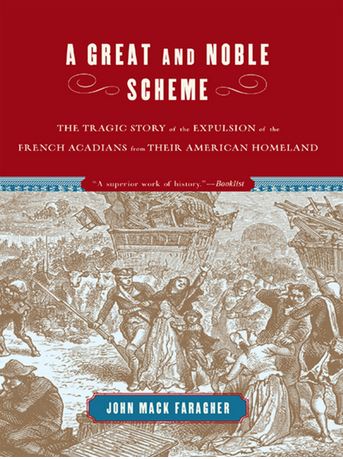
During the trip I kept a copy of John Mack Faragher's A Great and Noble Scheme (2005:W.W. Norton & Company) which was an easy introduction to the story of the Acadian people and the consequences of living  in a place and time among three warring states - the Micmac First Peoples, France and England.


When "Le Grand Derangement"  began in September 1755 and ended in December 1755, over 7000 Acadian people were dispersed into ships, scattered throughout the British colonies on the eastern seaboard and some French colonies such as Saint Dominigue (present day Haiti).  Exiled from their homeland, many never returned to Acadia. Thousands of other Acadians fled to surrounding territories in what in now northern Maine, Prince Edward Island and New Brunswick.

I highly recommend all members of our family become aware of their Acadian ancestors and their story. Contact me at FrancoAmericanGray@gmail.com.


Below is a recap of the stories written about Acadians in this blog so far.  This list includes some early posts that may not have been well researched but I am reviewing them for accuracy and hope they will "make the cut"!

Tuesday, June 10, 2014

8) Researching the Life of British Loyalist Abner Wolcott: Thank You, Roger Wolcott

Roger Wolcott 1946-2012

Thank you for your research about your ancestor, Abner Wolcott
 AND
 thank you to your family
 who generously shared your work with us
 and
 allowed it to be posted on this blog.

FrancoAmerican Gravy

7) Researching the Life of British Loyalist, Abner Wolcoot


And now back to Abner Wolcott and his family who made their way from the Hudson-Champlain Valley up the Richelieu River to the refugee camp in Sorel, Quebec.  The Wikipedia entry on Sorel states:
"The purchase was eventually made in 1781 and Sorel became a clearing house for the steady stream of Loyalist refugees from the south. A certain number of them settled in Sorel, forming the nucleus of the English population. Another addition was Sorel being selected as one of the stations for "Military Invalids", or “Outside Chelsea Pensioners" as they were also called. These old soldiers and their dependents, numbering several hundreds, were sent to Sorel under the medical care of Dr. Christopher Carter.
The earliest efforts for the propagation of the Protestant religion in Canada were made in Sorel. The continued influx of Loyalists during the year 1783 into the Seigniory prompted the population to search out a permanent Minister, and so at the end of the year, a petition was sent to the Society for the Propagation of the Gospel in Foreign Parts, begging them to send a Minister of the Gospel to reside in the Seigniory.
Following the request, the Reverend John Doty embarked during the month of April 1784 at Gravesend, England, and arrived at Quebec in June, and at Sorel on the 4th July 1784, where he celebrated Divine Service and preached his first sermon. This is the date of the foundation of the Anglican parish in Sorel and the firstAnglican mission in Canada.
The chapel where the faithful united was a wooden building located at the end of King Street, a few steps from the Richelieu market. This building had already served as a military storehouse."

Abner Wolcott lost no time acquiring property in the region. Thanks to Wolcott cousins in Quebec and especially the research of Roger Wolcott, I can post the chronology of Abner's land transactions beginning with lands he purchased 65 kilometers southwest of Sorel on the island known as 
"Ile de Bouchard".


Many of the records listed below were transcribed from the notarial records of
Barthelemy Joliette


If you read the entries you will soon see that the lands Abner purchased were primarily on the Ile de Bouchard in the Saint Lawrence.  On Google maps, the island is still there between Vercheres and Saint Sulpice.


Photo from Lanaudiere Tourism

It looks like it is possible via the Lanaudiere Tourist web page, to book a boat tour of the island along with L'Ile de Ronde.  Check It Out Here.

Sunday, June 8, 2014

6) Researching the Life of a British Loyalist: Abner Wolcott, Loyalty to the Crown

Abner's Loyalty to the Crown

Exactly what Abner Wolcott did as a Loyalist, isn't documented with sources. The Wolcott Society states he hauled provisions for the British:
Abner Wolcott, b. 1749, d. 1833 Sorrel, Quebec. He purchased 150 acres of land at New Haven VT in 1775, was a Loyalist, and hauled provisions for the British. He was taken prisoner in 1777 and his property declared forfeited in 1778. In 1778 he escaped to Canada where he was given compensation for his losses by the British government in 1783 at Sorel, Quebec. By 1787 he had settled on Isle St. Bouchard in the St. Lawrence River, in Vercheres parish. He and son, John, returned to Vergennes, Vermont, about 1800, and soon after he returned to Canada where they took the Oath of Allegiance to the Crown in 1803. During this visit to Vermont he is said to have visited a Charlotte Wolcott, b. c.1773, who married Hosea Bridges 1797 at Western MA, the marriage also recorded at Brookfield MA; m. (1) Catherine Griffen 1772 Oxford, CT, m. (2) Mrs. Dorothy Redman 1821. NOTE: Members of this family usually spelled their name Wilcott or Willcott in Canada, but some later changed to Wolcott when they returned to the United States.
Source: The Wolcott Family Web Pages accessed 6 June 2014.  

Another story states Abner was at the Battle of Saratoga, fled after the battle to a refugee camp in Sorel, Quebec. The Battles at Saratoga were fought on September 19th and October 7th, 1777.  When reading the following documents in the Vermont Archives,  Abner appears to still be in the present day vicinity of Vermont and Skenesborough (present day Whitehall) in the following months.  Not only was he present in January 1778, he appears to be still useful in the service of the continental forces which is very strange because the week before the Council and President Thomas Chittenden authorized a Mr. Eli Roberts to dispose of the property of DAVID REMMINGTON and ABNER WOLCOTT.  Perhaps for the well being of his wife and children he cooperated with the Continentals until he could safely bring his family to Sorel, Quebec


If there is guilt by association, Abner Wolcott has that too. His father in law, Charles Griffin is documented on the United Empire Loyalist Association of Canada  (UELAC) as a trooper in Jessups's Rangers, the Loyalist band of men who rallied around Ebenezar and Edward Jessup along the upper Hudson River in present day Warren County, New York.  The UELAC site provides a download of a paper by Bill Glidden, a historian associated with the New York State Military Museum in Saratoga and the UELAC, about Jessup's Troops.  I highly recommend checking out his story about the Jessup Brothers.


So there you have it.  For Mylott Family members who check out this blog, you are descended from two Tories or Loyalists. Take your pick.  Abner Wolcott (174 -1833) was the great grandfather of Robert Mylott (Robert Milot) born in Vercheres in 1832, immigrated to Whitehall, married, raised a family, farmed and died there in 1907.  Charles Griffin (1720-   ), Abner's father in law,  trooper in the Jessup Corps, was Robert Mylott's great great grandfather.


5) Researching the Life of a British Loyalist: Abner Wolcott - 3 Dangling Threads

 Abner Wolcott 1747-1833
and
 his wife
Catherine Griffin 1753- 1821


I am going to put aside the origins of Abner Wolcott and his grandfather to focus on the next little mystery with the documentation of his marriage to Catherine Griffin in Oxford, Connecticut Colony on January 8, 1772 or was it December 4th 1751?  The Barbour Collection: "The Barbour Collection of Connecticut Town Vital Records", Vol 8 - Derby 1655-1852, General Editor - Lorraine Cook White, Baltimore, Maryland, Genealogical Publishing Co., Inc, 1997, p. 229 uses the December date.

So now there are two dangling threads that need to be snipped or pulled: 1) Abner's parents, birthplace and 2) marriage dates with Catherine Wisebury.

After his marriage records of Abner Wolcott's divided loyalties and the Abner researcher is making a note to locate and read the original marriage document. Sometime after their marriage, Abner and Catherine moved west like many other colonists in the lands of the Wentworth or New Hampshire Grants.  These were the lands, east of the Hudson River and Lake Champlain, claimed by New Hampshire as part of their westward expansion and New Work as part of their northern New Netherland legacy. Eventually, the settlement created the state of Vermont.

Thanks to the kind person who created this map and put on Wikipedia

and then here is #3 dangling thread.....
Accordingly, Abner purchased 150 acres of land in the vicinity of Castleton, New Hampshire Grants or today Vermont.  This was also where his father in law, Charles Griffen, acquired land.  As an Abner researcher, want to locate the deed whereby Abner acquired this land after his marriage and before the American Revolution because he was soon to loose it and everything he had except his life, wife and children!


Saturday, May 31, 2014

4) Researching the Life of a British Loyalist: Abner Wolcott's grandfather - redeemed, unredeemed or we will never really know.


The Wolcott Society's Working Hypothesis (that's my name for this theory!) is that John Wolcott of Brookfield in Massachusetts Colony and probable ancestor of Abner Wolcott as well as the Mylotts of Whitehall, Hudson Falls, and Waterford, NY, was captured as a young teen in 1708 by French allied Native Americans.  He was restored to his New England Wolcott family in Brookfield after 7-8 years of living with indigenous people and acculturing into their native community. Upon his return to Brookfield, his family bestowed acres and acres of land to him, he participated in the local militia,  married his sister in law Dinah Walker,  impregnated her but ultimately abandoned his Wolcott family, and wife soon before their child was born.


The abandonment of his birth and wedded family, his Protestant religion, and his English colonial community caused such a trauma that a myth was created by and for his English brethren to come to terms with his voluntary withdrawal from their community and religious beliefs.  The Myth said John Wolcott was killed on a hunting expedition on the Connecticut River and thus he never rejected his birth family.

The Wolcott Society Hypothesis states while the myth spread,  John Wolcott was really alive and well living north of Fort Number Four along the Connecticut River and he started another family, possibly with an indigenous woman, while providing for them by hunting and trapping.  He severed all contact with his English family but likely continued  to be in contact with the Abenaki who were pushed northwards, out of New Hampshire lands to areas along the St Francis River and Lac St Francis in Quebec.  Supporting  the hypothesis, the society cites the small island in the Connecticut River that came to be called Walcott's Island!  Here it is on Google Maps: Walcott Island along the Connecticut River.


At first glance the entire story appears contrived and made to fit the DNA evidence acquired by the Wolcott DNA project.  However, several years ago I read, and reread, "The Unredeemed Captive" by John Demos.  Being familiar with the story of Eunice Williams, a captive of the Deerfield Raid who was born within a year or two of John Wolcott and who declined restoration to her New England family, made me believe the story presented by the Wolcott Society with the support of DNA evidence may be right "on the mark".  As I recall Demos's story of Eunice, her English colonial community sought her return because they believed the worst possible outcome for a captive would be that she convert to the papist faith and abandon the Puritan moral world view.  That is likely the personal conflict John Wolcott struggled with when he returned to Brookfield after his captivity.  Ultimately, he made his choice - if the Wilcott Society has it right!


3) Researching the Life of a British Loyalist: Abner Wolcott, was his grandfather the captive?


A little more on John Wolcott, born circa 1695, proposed grandfather of Abner Wolcott & ancestor of the Mylotts of Whitehall, Hudson Falls and Waterford, NY AND the raid on Brookfield on October 13, 1708 that took John Wolcott captive. Excerpt is from ......

"History of North Brookfield, Massachusetts. Preceded by an account of old Quabaug, Indian and English occupation, 1647-1676; Brookfield records, 1686-1783"


1707 This was a year of quiet and general prosperity on our Hampshire county frontiers.  The newcomer at Brookfield this year was John Grosvenor, brother of the minister, who bought June 11, 1707,  the home-lots and lands, formerly belonging to John Ayres deceased.

1708 This year our authorities adopted the enemy's tactics, and sent ranging parties to the North, in search of Indians.  In February, Capt. Benj. Wright led a scout of picked men as far as Cowasset (Newbury, Vt.) where was the resort of an Indian clan. They went on snowshoes; but no Indians were found.

Strolling bands of savages would suddenly appear at different and unexpected points in our county, showing that they were always on the alert; and about a dozen persons were killed or captured.
Brookfield was once again to be the scene of bloodshed. I quote from Rev. Mr. Fiske's Historical Discourse: "Oct. 13, early in the morning, John Woolcott, a lad about 12 or 14 years old was riding insearch of the cows, when the Indians fired at him, killed his horse and took him prisoner.  The people at Jennings' garrison hearing the firing, and concluding the people at another garrison (Banister's) were beset, six men set out for their assistance, but were waylaid by the Indians. The English saw not their danger till they saw there was no escaping it. And therefore, knowing that an Indian could not look an Englishman in the face and take right aim, they stood their ground, presented their pieces wherever they saw an Indian without discharging them, excepting Abijah Bartlet, who turned to flee and was shot dead.

The Indians kept firing at the rest, and wounded three of them, Joseph Jennings in two places; one ball grazed the top of his head, by which he was struck blind for a moment; another ball passed through his shoulder, wounding his collar bone; yet by neither did he fall, nor was mortally wounded.  Benjamin Jennings was wounded in the leg, and John Green in the wrist.  They were preserved at last by the following stratagem.  A large dog hearing the firing came to our men; one of them, to encourage his brethren and intimidate the Indians, called out "Capt. Williams is come to our assistance, for here is his dog."  The Indians, seeing the dog, and knowing Williams to be a famous warrior, immediately fled, and our men escaped.  John Woolcott, the lad above mentioned, was carried to Canada, where he remained six or seven years during which time, by conversing wholly with Indians, he not only entirely lost his native language, but became so naturalized to the savages, as to be unwilling for a while to return to his native country. (He did return to Brookfield, married, and settled.)  Some years afterwards, viz. in March 1728, in a time of peace, he and another man having been on a hunting expedition, and coming down Connecticut River with a freight of skins and fur, they were hailed by some Indians; but not being willing to go to them, they steered (their canoe) for the other shore.  The Indians landed at a little distance form them; several shots were exchanged, at length Woolcott was killed."

Friday, May 30, 2014

2) Researching the Life of a British Loyalist: Abner Wolcott Origins

Now that I have reintroduced Abner Wolcott,  I must declare, in the interest of full disclosure,  there is more than one controversy about him.  Let's begin at the beginning.  Where was Abner Wolcott born and who were his parents?  It seems almost all internet searching leaves one feeling confident his father was Joseph Wolcott and his mother Content Blakeslee.  None of the internet sites give a date or place which make Abner's birth line questionable to me.  The line runs something like this
Abner Wolcott, son of
     Joseph Wolcott, son of
          John Wolcott, son of
               John Wolcott, son of
                    George Wlcott, son of
                         Henry Wolcott of Windsor, Connecticut Colony

I suspect the source identifying Joseph and Content as Abner's  parents comes from either one or both of the following books:


I haven't been to a research library to check either of them out because well, I guess, I am a laptop genealogist! But onto the question: where is the original source for Abner's parents?  I haven't found it and if anyone reading this has a copy of the original source, I and many others would be grateful if you could write a comment to steer us to the origin.

Otherwise, I may have to follow the Wolcott Society's argument that Abner's father was not Joseph Wolcott but rather John Wolcott who was a descendant of John Wolcott of Watertown.  The society coordinates the Wolcott DNA Project - pretty strong evidence of connectivity. If I am interpreting it correctly, the line line runs something like this:
     Abner Wolcott, (born 1747)
son of
          John Wolcott, (born circa 1729 somewhere along the Connecticut River)
son of
              John Wolcott, (born 1695 in Brookfield Massachusetts Colony)
son of
                   John Wolcott, (born 1660 in Newbury, Massachusetts Colony)
son of
                        John Wolcott, (born 1636 in Newbury, Massachusetts Colony)
son of
                              John Wolcott of Watertown, Massachusetts Colony who was born 1599 in Axbridge, Somerset, England.

The Wolcott Society proposes Abner was the son of John who was born circa 1729 to John Wolcott and a woman who was not his Brookfield wife. See THE ILLUSIVE WOLCOTTS.  John, the father (Abner's grandfather), abandoned his Brookfield wife, his Brookfield lands and his Brookfield life for the life he had known as a young captive of indigenous people probably aligned with French Quebec. These may have been Abenaki along the upper Connecticut River north of Fort Number Four in present day New Hampshire.  Using DNA evidence, the researcher with the Wolcott Society argues the five descending Johns and Abner are a distinct line. The story of John's, Abner's grandfather, return to a life in the wilderness after several years of captivity seems plausible, especially because his capture in 1708 coincides with Queen Anne's War (the War of Spanish Succession) in North America, 1702-1713 when many colonialists were taken captive in borderland raids.

In this brief overview with a link to the Wolcott Society, I hope to clearly explain this genealogical conundrum if not controversy.  Forgive me and please correct me in the comment section, or email me at FrancoamericanGravy@gmail.com if you can clarify any section.  I would be very appreciative for guidance from anyone with more experience and information about the ancestors of Abner Wolcott.

1) Researching the Life of a British Loyalist: Abner Wolcott in Focus,

Back in November 2010 I wrote about the line of British Loyalists in the paternal family of Arthur Mylott. The family name Mylott is an Anglicized form of Milot.  The name is from Nicolas Damien Milot dit Champagne a soldier in the French and Indian War who hailed from Villiers-le-Sec, France. Nicolas Milot had twelve children with his wife Marie Josephte Guyon.  Al of the children were baptised in Vercheres, Quebec and sadly, only six lived to adulthood. Their eighth child, Marie Joseph Milot married Catherine Wolcott, the daughter of Abner Wolcott and Catherine Griffin in Saint Sulpice, Quebec.


Abner Wolcott (spelled Robine Wilcotte in the image above) and the father of Catherine Griffin, Charles Griffin, were both British loyalists during the American Revolution.

In his lifetime, Abner left a trail of documentation from Connecticut, Vermont, Quebec and finally New York and all are tasty morsels of information for a family historian.  One Wolcott family researcher was Roger Wolcott of Quebec (1946-2012), another descendant  of Abner Wolcott and Catherine Griffin through their son Solomon Wolcott.

Roger Wolcott 1946-2012

In my next few entries, I hope to share some documentation a relative of Roger Wolcott, has kindly shared with me.  We will follow the trail of  documentation and perhaps discover what is missing to establish his line of ascendancy to the New England Wolcott families.  Ultimately, I hope the next several blog posts will help other Wolcott family members to share research about the life and times of Abner Wolcott as well as his ancestors and descendants.


Saturday, December 15, 2012

A Mylott in 19th Century Whitehall

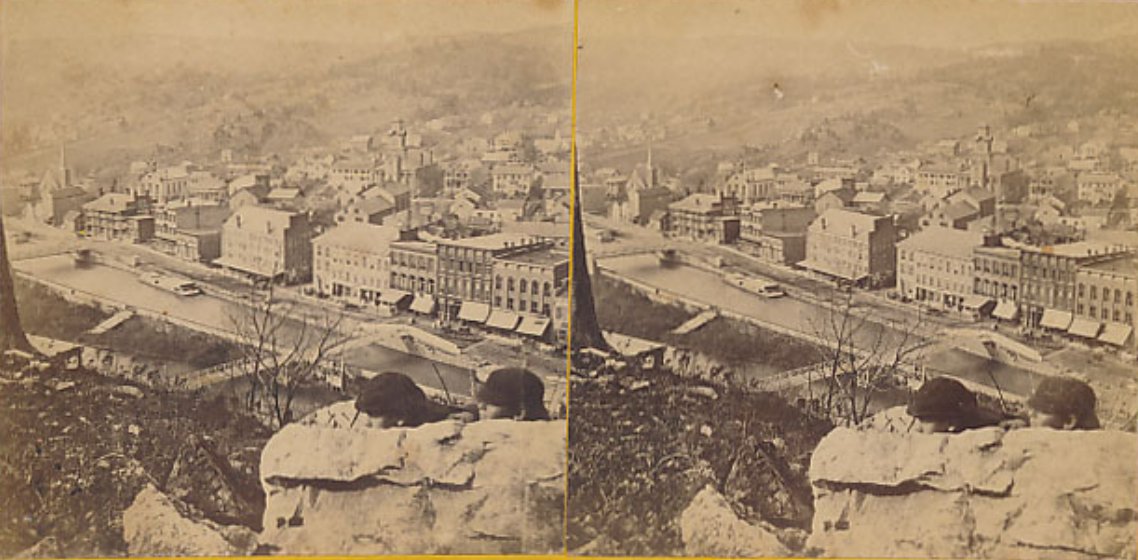
Robert Millot, alternatively spelled  Mailot or  Maylotte and finally, Mylott can be found in the 1850 census of Whitehall, New York working as a farm laborer on the Rathburn farm on the outskirts of town. Exactly when he arrived from Québec, we do not know.  What attracted the young man to this town at the southern end of Lake Champlain? Looking around Whitehall today, it would be hard to tell.  What did Whitehall look like in 1850?  When Robert Millot came into Whitehall,  he found a town bursting with activity, jobs, commerce and crime but, at that time, only a few French Canadians.  For several decades the region was the farmland of New England descendants.  With the opening of the Champlain Canal, Whitehall quickly became the center of economic activity in the north county attracting many new immigrants because it offered many new opportunities.  It was so busy and bustling, it even became the center of a fictional story entitled Ship Fever Times.

Below are several stereoscopic views and a few panoramic scenes of Whitehall in the 19th century, helping us to imagine the Whitehall  Robert Millot saw when he arrived.

A viewer, typical of the ones used to view the images below