
Showing posts with label cemetery. Show all posts
Showing posts with label cemetery. Show all posts
Monday, November 19, 2018
An Update to "Where Have All the Bodies Gone?"
Readers who were interested in the story posted in 2010 about Calvary Cemetery in Cohoes will be happy to learn that the Troy Irish Genealogy Society posted a listing of Catholic interments in Calvary Cemetery. Check this page and say "merci" to the Troy Irish Genealogy Society who were successful securing the list.


Sunday, May 15, 2016
Spring Tomb Sweeping Day
Subject: neglected, dirty family tomstones.
Time: a Saturday morning in May.
Location: St Joseph's Catholic Cemetery, Waterford NY.
Weather: Sunny with thunderstorms in the forecast.
Invitees: 2 cousins, a wife and a friend.
Material: 1 gallon of D2, several spray bottles of H2O, soft brushes, a few rags, rubber gloves and a funnel which was forgotten.
First Specimen: Headstone of Ida Mailloux, first wife of Emile Rivet. It wasn't easy to make out the words and that wasn't just because they were in French. We took out our gloves and poured to D2 into spray bottles. Twenty minutes later we took those soft brushes and gently scrubbed. The fungus and grime of 100 years literally fell off!

 |
| Gloves are important |


 |
| BEFORE |
 |
| AFTER |
Here's another before and after of the simple stone of Emile Rivet and his third wife, Malvina Hamel.


We are not certain where Marie Louise Lacasse, 2nd wife of Emile Rivet and mother of Claire, Albert & Ray, is buried in St. Joe's. There are several Lacasse headstones located in different sections. We found one with quite a lot of fungus adhering to it and sprayed it with D2. We didn't scrub it but will try the "let it alone" method and we'll check it out in a few weeks to see if it cleaned itself.

While walking around, we came across another stone with an interesting inscription because it was another family who came from St Jacques de l'Achigan where Emile Rivet was born and baptized. Seraphin Jean Vaine was born in St Jacques de l'Achigan in September 1841 and died in Cohoes in 1900. It was quite a nice stone by St Joe's standards.


Lastly, we stopped to check on Aunt Claire and Uncle Walker Yetto and felt glad to see the dates for Aunt Claire were completed and inscribed.

Sunday, September 25, 2011
Addie K. Johnson, wife of John Mylott, and Death on the Docks of New York City: TyphoMalarial Fever - a Discarded Diagnosis
In the 21st century, clinicians know typhoid fever and malaria as two distinct diseases. However, in the 19th century, even experienced physicians may have been unable to to distinguish between them. When a doctor couldn't determine, the "catch all" diagnosis, "typhoidmalarial fever" was often used. This was the case in the death of great grandmother Addie K Johnson.
Addie K Johnson married John Mylott in Whitehall New York on the 15th of February 1882. Their marriage did not make its sixth anniversary because Addie Johnson died on New Year's Day 1888 on a canal boat docked in the Atlantic Basin in Brooklyn, New York. John Mylott was a Champlain canalman and navigated the water from New York Harbor to the St. Lawrence. Addie and John had several children in that short time: Walter Robert Mylott 1882-1934, Milo Benjamin Mylott 1884- 1937, George Leslie Mylott 1887-1964 and possibly an infant, Eleanor 188?-188?.


The Atlantic Boat Basin in Brooklyn where Champlain Canal
boats docked while in New York Harbor
It was customary for the wife and kids to live aboard in canaling season. So John, Addie, Walter, Benjamin, Leslie and Eleanor were, no doubt, all aboard the canal boat on many trips. December was late in the season to be traveling the Champlain canal and Hudson River and perhaps in 1887, the ice had not yet formed on the river so they made the trip to New York City with some cargo. Then something went wrong because on December 10th,1887 a doctor began attending Addie while the boat was docked in the Atlantic Basin in Brooklyn. Twenty one days later, in the early morning hours of New Year's Day 1888, the young mother was dead on the family's canal boat.

TyphoMalarial Fever
Meningitis and Convulsions
click on image for more detail


In the 21st century, there is no such diagnosis called TyphoMalarial Fever. Some of the credit in determining the fact that these are two separate diagnoses - before the advantage of modern microbiology and laboratory techniques, goes to the father of modern medicine, William Osler. A Canadian physician, Osler practiced in Montreal and later Baltimore where he was one of the four founders of John Hopkins Medical School. His famous contribution to medical literature, "The Principles and Practice of Medicine", a classic blend of keen observation, listening to complaints of patients, clinical experience was published four years after Addie K's death. Below is an abstract of a paper written in 2004 firmly giving Osler credit for his keen ability to differentiate typhoid from malaria.
Infectious Disease Clinics of North America: 2004 Mar;18(1):111-25.
Osler on typhoid fever: differentiating typhoid from typhus and malaria.
Cunha BA..Early in the history of medicine, physician had a difficult time differentiating acute febrile illnesses without localizing signs. Typhoid fever and malaria share common features, which caused diagnostic problems during the 1800s. Physician even introduced a new term, typho-malaria, a testimony to their diagnostic confusion. Osler, consummate clinician and careful observer, had vast experience with typhoid fever and malaria. He was able to easily discern between the key features of both of these infections. He also relied on fever patterns to clearly differentiate typhoid fever from malaria. Osler is credited for debunking the term typho-malaria. His clinical description of typhoid fever remains unsurpassed. Clinicians still can benefit greatly from reading Osler's clinical description of typhoid fever.
On a personal note, I doubt great grandmother Addie K. died from malarial in the midst of winter in New York City. The 1887-1888 winter, by all accounts, was unusually cold and later produced the "The Great White Blizzard of 1888" on the east coast and "The Children's Blizzard of 1888" in the upper mid west. Addie K's death certificate states the doctor began caring for her on December 10th. Malaria in New York City in December? It is much more likely Addie succumbed to typhoid due to using water for cooking and drinking directly from the Hudson River while navigating to New York City or while docked in the Atlantic boat basin. Sewerage into the river ran freely from the cities along the river - Troy, Albany, Kingston, Newburgh, Yonkers and Manhattan. Sanitation on barge boats was not treated and went directly into the waters and if Addie used a bucket dipped into the river water for her cooking, there was a good chance the culprit was typhoid.
There is one other possibility and that is that the death certificate is completely wrong. There is some evidence that Addie had an infant girl, Eleanor at the time of her death. Perhaps, the cause of death was puerperal fever, an infection after childbirth. We will never know.
Today, due to modern sanitation, hand washing, and a typhoid vaccination, typhoid fever and puerperal fever are infrequent.

The Lancet, 2002 Oct 26;360(9342):1339.
Addie K's body was returned to Whitehall and she is buried with her family in the North Granville Cemetery along NY route 22.


Saturday, October 30, 2010
Thinking of Ancestors on All Hallowed Eve
Below: Kinner or Wood Creek Cemetery, along Route 4 between Fort Anne and Whitehall, NY
Below: East Pownal Cemetery, Vermont


 |
| Kinner or Wood Creek Cemetery |
Below: North Granville, NY
 |
| An interesting monument |
 |
| John & Addie Mylott North Granville NY |
Below: East Pownal Cemetery, Vermont

 |
| John Wills and Annie Reed |
 |
| Pownal, Vermont |
Below: in St. Joseph's, Waterford, NY....


Monday, October 11, 2010
William Henry Wills and his service in the American Civil War
 |
| GAR stands for Grand Army of the Republic |
John Albert Berryman Wills and his wife Anne Reed came to the Adirondack mining town of Moriah for good reasons. First, he knew the business of miners. Secondly, his older brother William Henry Wills, was already there. Who was this brother of our ancestor John Albert Berryman Wills? William Henry Wills was born in March 1840 in St Uny Lelant, Cornwall making him three years John's senior.
The image below is from the 1851 census of England : William Henry is eleven years old and John Albert is 8 years old. Also listed are parents William and Lystra as well as siblings William Francis, Sarah, Lystra and Amy. Josiah is a border in the home:
of_England_in+Bowl_Uny_Lelant.jpg) |
| 1851 Census of England: Uny Lelant, village of Bowl |
William H Wills probably came to the United States alone or at least without another immediate family member and enlisted in the Union Army - what later was called the Grand Army of the Republic, serving for three years. We know this because he was not required to "declare his intent" to became an Unites States citizen; he could go directly to naturalization because of his military service. His naturalization papers state he served three years in the "War of the Suppression".
Here is an image of William H Wills' naturalization papers in county clerk's office (Elizabethtown, Essex County, NY)
 |
| Click on image to enlarge |
This document states:
"In the matter of William H. Wills on his naturalization, State of New York Essex County. William H Wills being duly sworn, says that for the continued term of five years, last past, he has resided in the United States, without residing at any other time during the said five years out of the territory of the United States, and that for one year last past he has resided within the state of New York, that he was three years in the service of the United States in the Army for the Suppression of the late rebellion and was honorably discharged & would refer to his discharge herewith exhibited & applies to become a citizen of the United States under the act in such case made & provided that he is a native of England now residing in the town of Moriah in the county and state aforesaid, of the age of 30 years, and now, or lately, owing allegiance to her Majesty the Queen of Great Britain and Ireland, do hereby declare, that it is my bona fide intention to became a naturalized citizen of the United States of North America, and to renounce forever all allegiance and fidelity to any and ever foreign Prince, Potentate, State or Sovereignty whatsoever; and particularly all allegiance and fidelity to her Majesty, the Queen of Great Britain and Ireland.
Subscribed and sworn this 7th day of May A.D. 1872
signed Wm H. Wills
before me
A McD?inney Dep clerk"
When I think of William H. Wills arriving in New York, I remember the Martin Scorsese film "Gangs of New York". There is a fine scene where young men, arriving from the Old World, are recruited "off the boat" by officers to serve in the Union Army. William was young and somehow ended up fighting in a war that was not his own. He fought in the New York 16th Infantry Regiment, Company F. As of this time, I write this, I do not know what battles he fought in but he survived and somehow ended up in Essex County, NY.
The New York State Military Museum in Saratoga Springs has an online history of the New York 16th Regiment here. I believed the New York Regiment was "mustered out" in 1863 but men who remained in the service were pulled or converted into a "national" regiment. (can't remember where I read that...so it isn't a fact yet!).
In Essex County, sometime between 1865 and 1875, William H. married Mary C. who was born in 1844 and died in October 22, 1876 (she is buried in the Whitney Street Cemetery, Port Henry). We find William and Mary listed together in the 1875 Census of New York State:
 |
| New York State 1875 Census, Town of Moriah, Essex County |
 |
| William H. Wills and Mary C. Wills are numbers 33 and 34 |
 |
| John A. Wills, Annie Wills, Elestra, William, Elizabeth and John A. Wills start on the fifth line |
After the death of his first wife on 22 October 1876, Wm H. Wills remarried to Carrie E. and it is their graves that were located by cousin Carol Ann in around 2001. Carol Ann shared this knowledge but it wasn't until I made my third trip to the cemetery that I was actually able to find the gravestone. I was helped by one of the trustees of the cemetery who shared some local history with me and a CD listing with names and a map. The map isn't exact but it can help if you go to look for the grave of Wm H. Wills and his wife Carrie E. Wills
 |
| Click on Image to Enlarge |
 |
| Moriah Union Cemetery is very beautiful in Autumn |
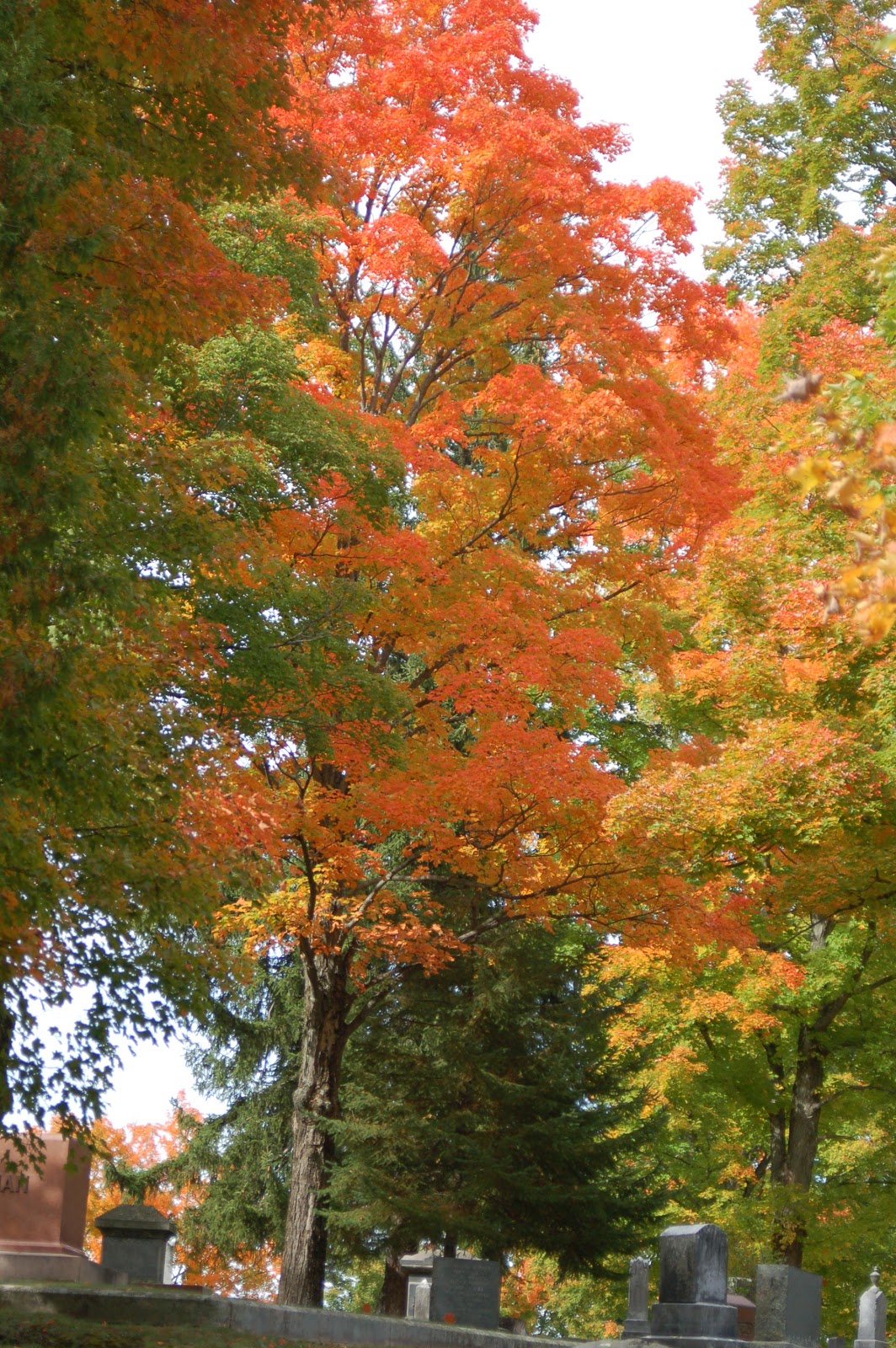


And here are the gravestones as I found them in late September 2010


 |
| The stone carver's error: "Wells" instead of "Wills" |
Then I remembered a scene from yet another movie! It was Penélope Cruz in Volver. In the opening scene she and other women from the village are performing the annual ritual of cleaning the gravestones of ancestors. Why not give it a try? Here are the during and after photos:


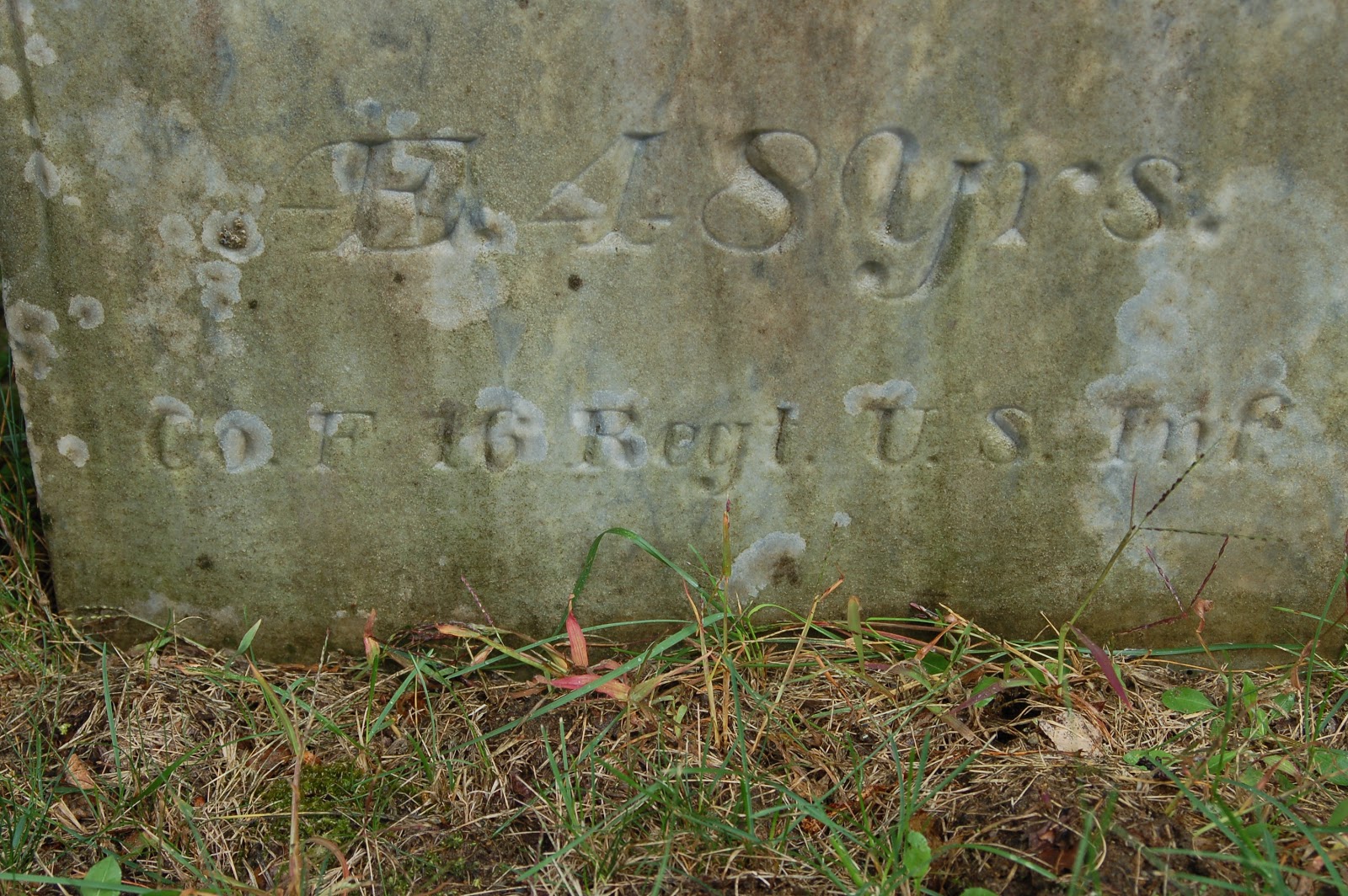


And after that I left. Perhaps, I will return another day to honor, William Henry Wills, the brother of my great grandfather who fought and survived battles of the United States Civil War.
Subscribe to:
Posts (Atom)